
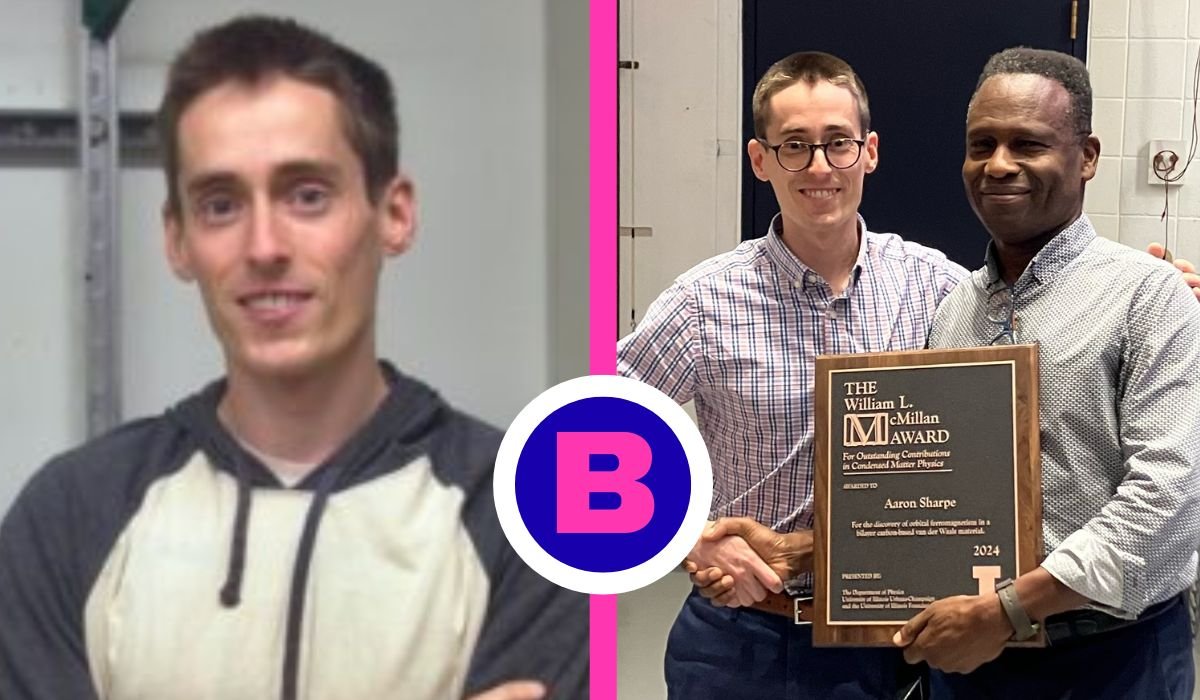
Aaron Sharpe Is A Condensed Matter Physicist Whose Research Has Helped Explore Some Of The Most Interesting Questions In Modern Quantum Materials Science. His Work Connects Experimental Physics With Emerging Materials Such As Graphene And Moiré Heterostructures, Where Tiny Changes In The Arrangement Of Atomic Layers Can Produce Remarkably Different Electronic And Magnetic Properties. Today, Aaron Sharpe Is A SIMES Associate Scientist At Stanford University And A Member Of The Goldhaber-Gordon Research Group.
What Makes Aaron Sharpe Particularly Interesting Is The Range Of Problems His Career Has Covered. His Research Has Included Graphene Electron Transport, Twisted Bilayer Graphene, Strongly Correlated Electronic States, Orbital Ferromagnetism, Moiré Superlattices, And New Methods For Precisely Fabricating And Measuring Two-Dimensional Materials. His Work Has Appeared In Major Scientific Journals, And His Contributions To Orbital Ferromagnetism Earned Him The 2024 McMillan Award.
Aaron Sharpe Quick Bio
| Quick Bio Information | Details |
|---|---|
| Full Name | Aaron Sharpe |
| Research Field | Condensed Matter Physics |
| Current Institution | Stanford University |
| Current Position | SIMES Associate Scientist |
| Research Area | Quantum Materials And Two-Dimensional Materials |
| Main Materials | Graphene, Hexagonal Boron Nitride, And Moiré Systems |
| Doctoral Degree | Ph.D. In Applied Physics |
| Doctoral Institution | Stanford University |
| Doctoral Research Group | Goldhaber-Gordon Group |
| Undergraduate Degree | B.S. In Physics |
| Undergraduate Institution | Rice University |
| Stanford Ph.D. Period | 2014–2020 |
| Rice University Period | 2010–2014 |
| Sandia Position | Truman Fellow |
| MIT Position | Visiting Scientist |
| Current Research Group | Goldhaber-Gordon Group |
| Major Research Theme | Correlated States In Moiré Materials |
| Notable Recognition | 2024 McMillan Award |
| Awarded For | Discovery Of Orbital Ferromagnetism In A Bilayer Carbon-Based Van Der Waals Material |
| Professional Field | Experimental Condensed Matter Physics |
These Details Are Supported By Sharpe’s Professional Biography, Stanford Profiles, His Research Group, And The University Of Illinois Physics Department.
Early Academic Background
Aaron Sharpe Began His Higher Education At Rice University, Where He Studied Physics From 2010 To 2014. His Interest In Experimental Research Developed During His Undergraduate Years Through Research Experiences In Several Laboratories. His Professional Biography Records Undergraduate Research With The Mittleman Group At Rice University, Along With Earlier Research Experiences At The University Of Chicago And The University Of Colorado At Boulder. He Also Worked As A SURF Student In The Microdevices Laboratory At NASA’s Jet Propulsion Laboratory In 2013.
These Experiences Help Explain The Experimental Direction Of His Later Career. Rather Than Focusing Only On Abstract Theory, Sharpe Developed Experience With Real Materials, Devices, Measurements, And Laboratory Techniques. That Foundation Became Particularly Valuable When He Later Began Working With Atomically Thin Materials Whose Properties can depend strongly on extremely small structural changes.
Stanford University And His Ph.D.
After Rice University, Aaron Sharpe Continued His Education At Stanford University, Where He Completed A Ph.D. In Applied Physics Between 2014 And 2020. He Conducted His Doctoral Research In The Goldhaber-Gordon Group, Working On Correlations In Moiré Heterostructures.
His Doctoral Work Placed Him In One Of The Fast-Growing Areas Of Condensed Matter Physics. Moiré Materials Allow Scientists To Create New Electronic Environments By Combining Atomically Thin Layers At Carefully Controlled Angles. These Structures Can Produce Flat Electronic Bands And Strong Electron-Electron Interactions, Making Them Valuable Platforms For Studying Unusual Quantum States. Sharpe’s Graduate Research Helped Establish The Direction That Would Continue Through His Later Career.
What Does Aaron Sharpe Study?
Aaron Sharpe’s Research Can Be Understood Through A Few Closely Connected Ideas: Graphene, Two-Dimensional Materials, Moiré Heterostructures, Strongly Correlated Electrons, Magnetism, And Superconductivity. Graphene Is An Atomically Thin Form Of Carbon With Unusual Electronic Properties. When Graphene Is Combined With Another Layer Or Rotated Relative To Another Graphene Sheet, Its Electronic Structure Can Change In Significant Ways.
The Resulting Moiré Pattern Acts Almost Like A New Large-Scale Lattice Superimposed On The Original Atomic Structure. This Can Alter How Electrons Move And Interact. Sharpe’s Research Has Examined These Effects Experimentally, helping researchers understand how microscopic structure can lead to unexpected collective behavior. Stanford’s publication record shows his continuing involvement in research on Moiré Systems, Correlated States, Magnetotransport, And Graphene.
Aaron Sharpe And Graphene Research
Graphene Has Been A Central Material In Aaron Sharpe’s Scientific Career. One Reason Is That Electrons In Graphene Can Move In Unusual Ways, making it an excellent platform for studying electronic transport and quantum phenomena. Sharpe’s earlier research included work on ballistic Dirac Fermions, including research into methods for creating highly collimated electron beams in graphene.
His later work moved deeper into correlated quantum phenomena. By studying twisted and layered graphene systems, Sharpe and his collaborators could investigate what happens when electron interactions become especially important. This research has connected basic questions about electronic transport with broader questions about magnetism, topology, and superconducting behavior.
Understanding Moiré Heterostructures
The Term “Moiré Heterostructure” May Sound Complicated, But The Basic Idea Is Relatively Simple. Imagine Placing Two Very Fine Patterns On Top Of One Another While Rotating One Slightly. A Larger Repeating Pattern Appears. In Two-Dimensional Materials, A Similar Effect Happens When Atomic Layers Are Stacked With A Small Difference In Orientation.
The Resulting Moiré Pattern Can Change The Effective Electronic Landscape Experienced By Electrons. In Graphene Systems, This Can Produce Narrow Or Flat Bands In Which Electron Interactions Become Much More Important. Scientists Can Then Study Phenomena That Are Difficult To observe in ordinary materials. Sharpe’s doctoral work and subsequent publications have made these Moiré Structures a central theme of his research.
Strongly Correlated Electronic States
One Of The Most Important Ideas Behind Aaron Sharpe’s Research Is Strong Electronic Correlation. Electrons Normally Behave According To Both Their Individual Energies And Their Interactions With Other Electrons. In Certain Materials, Those Interactions Become So Important That Electrons Cannot Be Described Effectively As Independent Particles.
Moiré Systems Are Particularly Useful For Studying This Problem Because Their Electronic Bands Can Become Very Narrow. When Electrons Have Fewer Energetic Options Available, Their Mutual Interactions Can Play A Much Larger Role. This Can Lead To Insulating, Magnetic, Superconducting, Or Topological States. Sharpe’s Research Has Helped Investigate These Possibilities Through Careful Transport Measurements And Material Fabrication.
Research On Ferromagnetism
One Of Aaron Sharpe’s Most Recognized Contributions Is His Work On Orbital Ferromagnetism In Graphene-Based Moiré Materials. A Major Study Published In Science Reported Evidence For A Ferromagnetic State In Twisted Bilayer Graphene Near Three-Quarter Filling Of The Conduction Miniband. The Researchers Observed Ferromagnetic Hysteresis And A Large Anomalous Hall Effect, With Measurements Suggesting The Possibility Of An Incipient Chern Insulating State.
This Work Was Important Because It Showed How A Carefully Designed Two-Dimensional Material Could Support Magnetic Behavior Emerging From Electronic Structure And Interactions. The Significance Of Sharpe’s Contribution Was Later Recognized By The 2024 McMillan Award From The University Of Illinois Department Of Physics. The Award Specifically Cited His Discovery Of Orbital Ferromagnetism In A Bilayer Carbon-Based Van Der Waals Material.
Aaron Sharpe And Superconductivity Research
Superconductivity Is Another Important Part Of The Broader Scientific Story Surrounding Moiré Materials. Superconductors Can Carry Electrical Current With Extremely Low Resistance Under Suitable Conditions, But Understanding How Superconductivity Emerges In Unusual Quantum Materials Remains A Major Research Challenge.
Twisted Graphene Systems Have Become Important experimental platforms because their electronic bands can be tuned through layer orientation and carrier density. Stanford’s publication record notes that magic-angle twisted bilayer graphene can host exotic correlated states including superconductivity and ferromagnetism. Sharpe’s work has contributed to the experimental investigation of these systems and the conditions under which unusual electronic phases appear.
Experimental Methods And Scientific Techniques
Aaron Sharpe’s Research Is Not Limited To Studying Existing Samples. A Major Part Of His Work Involves Building And Characterizing Sophisticated Two-Dimensional Material Devices. His Research Record Includes Work On Deterministic Fabrication Of Graphene And Hexagonal Boron Nitride Moiré Superlattices, Where The Relative Orientation Of Layers Is Critically Important.
This Precision Matters Because A Very Small Change In Twist Angle Can Alter The Electronic Properties Of A Moiré Device. Recent Work Involving Sharpe Has Used Techniques Including Raman Spectroscopy, Second-Harmonic Generation, Torsional Force Microscopy, And Cryogenic Transport Measurements To Determine Structural Orientation And Study Resulting Electronic Behavior. Such Techniques Make It Possible To Connect The Physical Structure Of A Device With Its Quantum Properties.
Aaron Sharpe’s Professional Career
After Completing His Ph.D. At Stanford, Sharpe Continued His Research As A Truman Fellow At Sandia National Laboratories From 2020 To 2023. He Then Became A Visiting Scientist At MIT During 2023–2024. These Positions Expanded His Research Experience Beyond His Doctoral Environment And Connected Him With Other Major Centers Of Quantum Materials Research.
In 2024, Sharpe Returned To Stanford As A SIMES Associate Scientist. Stanford Currently Lists Him In The Energy Sciences Area, And The Goldhaber-Gordon Group Lists Him Among Its Staff Scientists. His Career Therefore Represents A Progression From Undergraduate Research To Doctoral Work, National Laboratory Research, An MIT Visiting Position, And His Current Scientific Role At Stanford.
Major Publications And Scientific Contributions
Aaron Sharpe’s Publication Record Shows A Broad Interest In Quantum Materials Rather Than A Single Narrow Topic. His work has included studies of ballistic electron transport, twisted bilayer graphene, magnetic field effects, Wigner crystal states, moiré superlattices, and topological and correlated states in graphene.
Among His More Recent Research Contributions Is A 2024 PNAS Study On Deterministic Fabrication Of Graphene–Hexagonal Boron Nitride Moiré Superlattices. The Research Addressed A Practical But Important Problem: accurately determining crystal orientation before stacking layers. Sharpe And His Collaborators Also Contributed To Research On Torsional Force Microscopy, A Technique That Can Help Determine Twist Angles And Strain In Van Der Waals Moiré Structures.
His Publication Record Also Extends Into Recent Research On Topological Bands And Correlated States In Helical Trilayer Graphene, Published In Nature Physics, As Well As 2026 Work On Directional Ballistic Magnetotransport. These Studies Show That Aaron Sharpe’s Research Continues To Develop Rather Than Remaining Limited To His Earlier Graduate Work.
Awards And Recognition
The 2024 McMillan Award Is One Of The Most Important Recognitions Associated With Aaron Sharpe. The University Of Illinois Department Of Physics Awarded Him The Prize For Work Conducted At Stanford, Specifically Recognizing The Discovery Of Orbital Ferromagnetism In A Bilayer Carbon-Based Van Der Waals Material.
The Recognition Is Significant Because The McMillan Award Highlights Important Contributions To Condensed Matter Physics. For Sharpe, It Reflects The Scientific Importance Of His Experimental Research Into Magnetic States In Two-Dimensional Quantum Materials. It Also Places His Work Within The Larger Development Of Moiré Materials As A Platform For Exploring New Forms Of Quantum Matter.
Why Aaron Sharpe’s Research Matters
The Importance Of Aaron Sharpe’s Research Goes Beyond Graphene Itself. Moiré Materials Give Scientists A Way To Engineer Electronic Properties By Controlling The Geometry Of Atomically Thin Layers. This Creates A Kind Of Experimental Playground Where Researchers Can investigate Magnetism, Correlation, Topology, And Superconductivity In A Highly Tunable Environment.
Sharpe’s Research Also Shows Why Fabrication And Measurement Are So Important In Modern Condensed Matter Physics. A Theoretical Prediction Is Only As Useful As The Experiments That Can Test It. By Developing Precise Devices And Measurements, Researchers Can Determine Whether Unusual Quantum States Actually Occur And Under What Conditions They Appear.
Aaron Sharpe And The Future Of Quantum Materials
Research Into Moiré Materials Is Still Developing Rapidly. Scientists Continue To Ask How Different Twist Angles, Layer Combinations, Strain, Carrier Density, And Magnetic Fields Can Change The Behavior Of Electrons. Recent Publications Involving Sharpe Demonstrate That These Questions Remain Active, With Current Work Extending Into Helical Trilayer Graphene And Other Quantum Materials.
The Future Of The Field Is Likely To Depend On Better Control Over Material fabrication and more precise measurements. Sharpe’s work on deterministic fabrication, twist-angle characterization, and low-temperature transport fits naturally into that direction. The long-term value may not simply be one particular discovery, but a better understanding of how scientists can deliberately create and investigate new quantum states.
Final Thoughts
Aaron Sharpe Has Built A Scientific Career Around A Fascinating Question: What Happens When Electrons Are Placed In Carefully Designed Two-Dimensional Materials Where Their Interactions Become Impossible To Ignore? From His Early Research Experiences And Physics Education At Rice University To His Ph.D. At Stanford, Work At Sandia National Laboratories And MIT, And Current Role At Stanford, His Career Has Followed The Development Of Moiré Materials From An Emerging Research Area Into A Major Field Of Quantum Materials Science.
His Work On Graphene, Moiré Heterostructures, Orbital Ferromagnetism, Magnetotransport, And Correlated Electronic States Has Made Him A Notable Experimental Condensed Matter Physicist. His 2024 McMillan Award Further Recognized His Contribution To The Discovery Of Orbital Ferromagnetism.
For Readers Searching For Aaron Sharpe’s Biography, Career, Research, Or Achievements, The Most Important Thing To Understand Is That His Work Is Part Of A Much Larger Scientific Effort To Learn How Quantum Materials Can Be Designed And Controlled. His Research Offers A Window Into A Field Where Tiny Changes In Atomic Arrangement Can Produce Entirely New Physical Behavior. That Makes Aaron Sharpe’s Career Not Only A Story About One Physicist, But Also A Useful Introduction To One Of The Most Exciting Areas Of Modern Condensed Matter Physics.
FAQs About Aaron Sharpe
Who Is Aaron Sharpe?
Aaron Sharpe Is A Condensed Matter Physicist And SIMES Associate Scientist At Stanford University. His Research Focuses On Two-Dimensional Quantum Materials, Including Graphene And Moiré Heterostructures. He Is Also A Member Of The Goldhaber-Gordon Research Group At Stanford.
What Does Aaron Sharpe Research?
Aaron Sharpe Studies Electronic And Quantum Phenomena In Materials Such As Graphene And Other Van Der Waals Heterostructures. His Research Has Included Strongly Correlated States, Ferromagnetism, Magnetotransport, Moiré Superlattices, And Related Quantum Materials.
Where Did Aaron Sharpe Study?
He Earned His B.S. In Physics From Rice University And Later Completed A Ph.D. In Applied Physics At Stanford University. His Stanford Doctoral Work Was Conducted In The Goldhaber-Gordon Group.
What Is Aaron Sharpe Known For?
Aaron Sharpe Is Particularly Known For Experimental Research On Graphene And Moiré Materials, Including Work Contributing To The Discovery Of Orbital Ferromagnetism In A Bilayer Carbon-Based Van Der Waals Material.
What Is A Moiré Heterostructure?
A Moiré Heterostructure Is Created When Two Atomically Thin Material Layers Are Stacked With A Controlled Difference In Their Orientation. The Resulting Moiré Pattern Can Change The Electronic Environment And Produce New Quantum Behavior. These Structures Are Central To Much Of Sharpe’s Research.
Has Aaron Sharpe Worked On Superconductivity?
Yes. His Research Career Has Included Experimental Studies Of Twisted Graphene And Other Moiré Systems In Which Correlated Electronic States, Including Superconducting Behavior, Are Investigated. Stanford’s Research Record Identifies Superconductivity And Ferromagnetism Among The Exotic States That Can Occur In Magic-Angle Twisted Bilayer Graphene.
What Award Did Aaron Sharpe Receive?
Aaron Sharpe Received The 2024 McMillan Award From The University Of Illinois Department Of Physics. The Award Recognized His Discovery Of Orbital Ferromagnetism In A Bilayer Carbon-Based Van Der Waals Material, For Work Conducted At Stanford University.
Where Does Aaron Sharpe Work Today?
As Of 2026, Stanford Lists Aaron Sharpe As A SIMES Associate Scientist In Energy Sciences. He Is Also Listed As A Staff Scientist In The Goldhaber-Gordon Group At Stanford.
Learn more and explore exciting content on: Kim Haesol: Biography, Academic Career, Research, and Achievements









Leave a Reply