
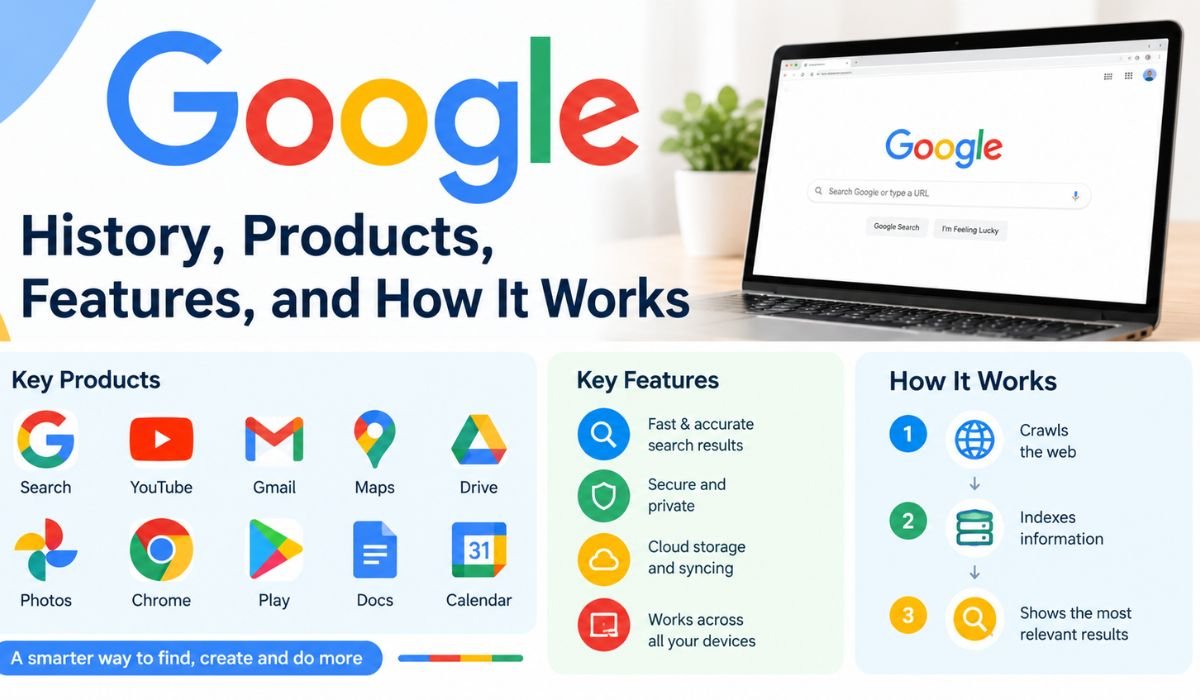
Google Has Become One Of The Most Familiar Names On The Internet. Every Day, People Use Google To Find Answers, Learn New Skills, Check Directions, Send Emails, Watch Videos, And Discover Businesses. What Began As A Search Engine Project Has Grown Into A Large Technology Company With Products Used By Individuals, Students, Professionals, And Organizations Around The World.
However, Google Is Much More Than A Website Where People Type Questions. Its Technology Supports Online Advertising, Cloud Computing, Mobile Devices, Digital Communication, Productivity Tools, And Artificial Intelligence. Services Such As Gmail, Google Maps, YouTube, Android, Google Drive, And Gemini Help People Complete Different Tasks Through Connected Digital Experiences.
Understanding Google Means Looking At Both The Company Behind These Products And The Technology That Makes Them Work. This Guide Explores Google’s History, Founders, Popular Services, Business Model, Search Features, AI Developments, Privacy Concerns, And Importance In 2026. It Also Explains How To Use Google More Effectively And Make Better Decisions About The Information You Find Online.
Quick Bio Information: Google
Company Name
Google LLC
Founded
September 4, 1998
Founders
Larry Page And Sergey Brin
Headquarters
Mountain View, California, USA
Parent Company
Alphabet Inc.
CEO
Sundar Pichai
Industry
Technology, Internet Services, And Digital Advertising
Former Name
Google Inc.
IPO Year
2004
Alphabet Restructuring
2015
Main Product
Google Search
Popular Services
Gmail, YouTube, Google Maps, And Google Drive
Mobile Operating System
Android
Web Browser
Google Chrome
AI Product
Google Gemini
Cloud Platform
Google Cloud
Business Model
Advertising, Cloud Services, Subscriptions, And Hardware
Stock Tickers
GOOG And GOOGL (Alphabet Inc.)
Area Served
Worldwide
Official Website
https://about.google/
What Is Google?
Google LLC Is An American Multinational Technology Company Known For Its Search Engine, Online Advertising, Software, Cloud Services, Artificial Intelligence, And Consumer Devices. Its Headquarters, Commonly Known As The Googleplex, Is Located In Mountain View, California. Google Operates Internationally And Provides Services For Personal, Educational, And Business Use.
Although Many People Use The Word Google To Mean Google Search, The Company Offers A Much Wider Range Of Products. Gmail Supports Email Communication, Google Maps Helps Users Explore Locations, YouTube Provides Video Content, And Google Workspace Supports Collaboration. Google’s Technology Also Powers Services For Developers And Businesses.
Google Is A Subsidiary Of Alphabet Inc., The Parent Company Established Through A Corporate Restructuring In 2015. This Distinction Matters Because Google Is One Part Of A Larger Corporate Organization. Alphabet Also Has Other Businesses And Research Activities, Including Work Connected With Autonomous Driving And Advanced Technology.
Who Founded Google?
Google Was Founded By Larry Page And Sergey Brin, Two Computer Scientists Whose Research Helped Change How People Find Information Online. They Met While Studying At Stanford University And Began Working On A search technology project That Explored Better Ways To Organize Web Pages.
Their Early Search Engine Used Links Between Websites As One Way To estimate the importance of individual pages. This approach helped distinguish their work from systems that relied heavily on matching search terms alone. The technology developed into a search engine originally associated with the name BackRub before Google became the company’s public identity.
Page And Brin Established Google In 1998. Their Goal Was To Make Online Information Easier To Find And Organize. As The Company Expanded, It Moved Beyond Search Into Advertising, Software, Mobile Technology, And Other Fields. Their Early Research Remains An Important Part Of Google’s History Because It Helped Establish The Foundations Of Modern Web Search.
The History Of Google
Google’s Story Began In The Late 1990s, When The Internet Was Growing Rapidly And Users Needed Better Ways To Find Useful Websites. The Company Was Founded On September 4, 1998, And Its Search Technology Soon Attracted Attention For Organizing Results In A Useful Way. Its Name Was Inspired By The Mathematical Term Googol, Which Refers To The Number One Followed By One Hundred Zeros.
In 2000, Google Expanded Its Advertising Activities, Helping Establish A Business Model That Connected Search With Relevant Commercial Messages. The Company Went Public In 2004 Through An Initial Public Offering, Giving Investors An Opportunity To Purchase Shares. During The Following Years, Google Added Products Such As Gmail, Google Maps, And Google Docs While Expanding Its Reach Through Acquisitions, Including YouTube In 2006.
A Major Organizational Change Came In 2015, When Google Became A Subsidiary Of Alphabet Inc. Sundar Pichai Became Google’s CEO That Year And Later Took On The CEO Role At Alphabet In 2019. Since Then, Artificial Intelligence, Cloud Computing, Mobile Technology, And Hardware Have Become Increasingly Important Areas Of Development. By 2026, Google Is Best Understood As A Broad Technology Ecosystem Rather Than Simply A Search Engine.
How Does Google Search Work?
Google Search Helps Users Find Information By Processing Web Pages And Matching Them With Search Queries. The Process Starts With Crawling, In Which Automated Programs Known As Crawlers Discover Pages Through Links, Sitemaps, And Other Methods. Google Then Processes Eligible Content And May Add Information About It To Its Search Index, A Large database Used To retrieve relevant pages.
When Someone Enters A Query, Google’s Systems Search Its Index And Evaluate Which Results May Best Answer The Question. Ranking Systems Consider Many Signals, Which Can Include Relevance, Content Quality, Usability, Location, And The Meaning Behind The Query. Different Searches Can Produce Different Types Of Results, Such As Websites, Images, Videos, News, Maps, Or Direct Answers.
Google Search Also Includes Sponsored Advertisements, Which Are Separate From Organic Search Results. Advertisers Can Pay To Display Eligible Ads, But Payment Does Not Automatically Buy A Higher Organic Ranking. Google Has Also Introduced AI Overviews, Which Summarize Information From Multiple Sources For Certain Queries. These Features Can Be Convenient, But Users Should Still Open Reliable Sources And Verify Important Claims. Not Every Web Page Is Indexed, And No Website Is Guaranteed A Particular Ranking.
Google’s Most Popular Products And Services
Google’s Product Ecosystem Covers Many Everyday Activities. Gmail Provides Email, Google Drive Stores Files, And Google Docs, Sheets, And Slides Help Users Create Documents, Spreadsheets, And Presentations. These Tools Support Collaboration By Allowing People To Share Work And, Where Permissions Allow, Edit Files Together. Google Meet Provides Video Meetings, While Google Calendar Helps Organize Appointments And Events.
Google Maps Offers Maps, Directions, Location Information, And Business Listings. Waze Focuses On Navigation And Driver Reports, While YouTube Allows Users To Watch, Publish, And Share Videos. Google Chrome Is A Web Browser, And Android Is A Mobile Operating System Used By Many Device Manufacturers. Google Photos Helps Users Store And Organize Pictures, While Google Translate Supports Communication Across Languages.
The Company Also Develops Pixel Smartphones, Nest Smart-Home Products, And Fitbit Wearable Technology. Google Cloud Offers Computing Infrastructure, Storage, Data Tools, And Other services for organizations. Product Availability, Pricing, And Features Can Differ By Country, Device, Subscription, And Account Type. Understanding These Differences Helps Users Choose Tools That Match Their Actual Needs Rather Than Assuming Every Feature Is Available To Everyone.
Google And Artificial Intelligence
Artificial Intelligence Has Become A Major Part Of Google’s Technology Strategy. Gemini Is Google’s Family Of AI Models And Products Designed To Help With Tasks Such As Writing, Summarizing, Learning, Coding, And Understanding Information. Depending On The Product And Account, Users May Be Able To Work With Text, Images, Files, Or Other Supported Inputs.
Google Also Uses AI In Search And Other Services. AI Overviews Can Provide Summaries For Certain Questions, While Machine-Learning Systems Help Organize Information And Support Features Across The Company’s Products. Google DeepMind Conducts Advanced AI Research, And TensorFlow Is An Open-Source Framework That Developers Can Use To Build Machine-Learning Applications. Google Also Develops Specialized Processors Known As Tensor Processing Units To Support AI Workloads.
These Tools Can Save Time And Help Users Explore Complicated Subjects, But They Have Limitations. AI Systems Can Produce Incorrect statements, overlook context, or present uncertain information too confidently. Users Should Check Important Medical, Legal, Financial, And Academic Information Against Reliable Sources. AI Can Assist Human Judgment, But It Should Not Replace careful verification when accuracy matters.
How Does Google Make Money?
Google Earns A Large Share Of Its Revenue Through Digital Advertising. Businesses Use Google Ads To Reach Potential Customers Through Eligible Search Placements And Other Advertising Channels. Advertisers May Target Campaigns According To Factors Such As Search Intent, Audience Settings, And Geographic Area. This Business Model Helps Support Many Services That Users Can Access Without Paying A Direct Subscription Fee.
Advertising Is Not Google’s Only Source Of Income. Google Cloud Provides Technology Services To Businesses, Developers, And Other Organizations. Google Also Earns Revenue Through Subscriptions, Paid Digital Services, Apps And Content Transactions, And Consumer Hardware. Products And Plans Change Over Time, So Current Pricing And Availability Should Be Checked On Official Product Pages.
Google’s Business Model Creates A Connection Between Free Services And Commercial activity. Users Receive Convenient Tools, While Businesses Pay For Advertising Or Technology. At The Same Time, This Relationship Raises Questions About Data Use, Ad Personalization, Competition, And Transparency. A Balanced Understanding Of Google Includes Both Its Practical Benefits And The Responsibilities That Come With Operating Large Digital Platforms.
How To Use Google More Effectively
A Few Simple Search Techniques Can Make Google More Useful. The First Is To Use Specific Words Rather Than Entering A Very Broad Question. For Example, Searching For “Beginner Photography Courses” May Be More Helpful Than Searching Only For “Photography” When You Want Lessons For New Learners. Adding A Location, Date, Or Other Relevant Detail Can Narrow The Results Further.
Quotation Marks Can Help Search For An Exact Phrase, Such As “digital marketing strategy.” A Minus Sign Can Exclude An Unwanted Term, As In jaguar -car. The site: Operator Can Restrict Results To A Particular Website, Such As site:example.com Google. These Operators Can Help When Ordinary Searching Produces Too Many Unrelated Pages.
It Is Also Important To Evaluate Search Results Carefully. Look At The Publisher, Publication Date, Supporting Evidence, And Purpose Of The Page. Sponsored Results May Be Useful, But They Are Advertisements. AI Summaries Can Offer A Starting Point, Yet Reading The Original Sources Provides More Context. For Important Decisions, Compare Multiple Reliable Sources Instead Of Depending On A Single Search Result.
Google For Students, Professionals, And Businesses
Google Offers Tools That Can Support Learning, Work, And Business Activities. Students Can Use Search To Explore Topics, Drive To Organize Files, And Docs To Draft Assignments. Teachers May Use Classroom And Other Education Tools To Share Resources And Manage Learning Activities, Depending On Their Institution’s setup and available subscriptions. Students Still Need To Check Sources And Follow Their School’s Rules About AI And Academic Work.
Professionals Can Use Gmail, Calendar, Meet, And Workspace Applications To Communicate, schedule meetings, and collaborate on projects. Shared documents can reduce the need to exchange multiple file versions, while cloud storage allows authorized users to access files across supported devices. These benefits depend on suitable permissions, account security, and reliable internet access.
Businesses Can Use Google Business Profile To Manage Eligible business information on Search and Maps, Google Ads To Promote Products, And Google Analytics To Understand Aspects Of Website Traffic. Developers May Use Google Cloud And Other Development Tools To Build Applications. Each Product Serves A Different Purpose, So Organizations Should Compare Costs, Privacy Requirements, Features, And Business Goals Before Choosing A Solution.
Google And Search Engine Optimization
Search Engine Optimization, Commonly Called SEO, Is The Practice Of Improving A Website So That Search Engines Can Discover, Understand, And Present Its Content Appropriately. For Businesses And Publishers, Google Search Can Be An Important Source Of Visitors. However, Good SEO Is Not About Repeating A Keyword As Many Times As Possible. It Starts With Understanding What Readers Need And Providing Useful, Original Information.
Google’s Search Systems Must Be Able To Discover And Process A Page Before It Can Appear In Relevant search results. Clear page structures, descriptive titles, useful internal links, accessible content, and technically sound websites can help search engines understand a site’s pages. Mobile usability, page performance, and a secure browsing experience also contribute to a better overall experience.
Google Search Console Helps Website Owners Monitor Search performance, inspect indexing information, and identify certain technical issues. It does not guarantee rankings, and there is no single trick that ensures a page reaches the top. Sustainable SEO focuses on reader value, accuracy, a clear website structure, and compliance with Google’s published guidance. Website owners should consult Google Search Central for current recommendations rather than relying on outdated shortcuts.
Google’s Privacy, Security, And Data Controls
Privacy Is An Important Consideration When Using Google Products. Depending On The Service And Settings, Google May Process Information To Provide Features, Maintain Security, Improve Services, And Personalize Certain Experiences. The Information Involved Can Differ Between Products, So Users Should Review The Relevant Privacy Notices Instead Of Assuming Every Service Handles Data In The Same Way.
Google Accounts Include Controls That Help Users Review Certain Activity Information And Manage Available Privacy Settings. Users Can Visit Their Google Account Dashboard To Explore Account Information, Review Security Options, And Manage Supported Activity Controls. Some Information Can Be Automatically Deleted According To Selected Settings, While Other Records May Be Retained For Specific Operational, Security, Or Legal Reasons.
Account Security Is Equally Important. Using A Strong, Unique Password, Enabling Two-Step Verification, And Reviewing Devices Connected To An Account Can Help Reduce The Risk Of Unauthorized Access. Passkeys Are Another Sign-In Option Supported By Google. Users Should Also Be Careful With Unexpected Emails, Suspicious Links, And Requests For Verification Codes. Good Digital Habits Make Google’s Services Safer And Help People Maintain Better Control Over Their Online Accounts.
Google’s Challenges And Criticism
Google’s Size And Influence Have Led To Ongoing Debates About Privacy, Competition, Advertising, And Access To Information. Regulators In Different Countries Have Examined Aspects Of Its Business Practices, Particularly Its Position In Search And Digital Advertising. These Matters Can Involve Complex Legal Questions, And It Is Important To Distinguish Final Court Decisions From Allegations, Appeals, And Cases That Remain Unresolved.
Publishers Have Also Raised Concerns About How Search Engines Use Online Content And How AI-Generated Summaries Might Affect Website Visits. Search Can Help People Discover publishers, but users may sometimes find answers directly on a results page without visiting the original source. The effects can vary by topic, query, publisher, and the design of the search experience. These changes have increased discussion about copyright, attribution, and the economic future of online publishing.
Other concerns involve content moderation, censorship, targeted advertising, and the handling of personal information. Supporters Of Google’s Services Point To Their Convenience, Reach, And Technical Capabilities, While Critics Emphasize Accountability And Market Power. A Fair Assessment Should Consider Evidence From Reliable Reporting, Official statements, and legal documents. Understanding These Debates Helps Users Make Informed Choices Without Ignoring Either The Benefits Or The Potential Risks Of Large Technology Platforms.
Google Products That Have Been Discontinued
Google Has Introduced Many Products Over The Years, But Not Every Service Has Continued Permanently. Google+, Its Social Networking Platform, Was Shut Down For General Consumers In 2019. Google Reader, A Popular RSS Feed Reader, Closed In 2013. These Examples Show How A Product Can Attract A Dedicated Audience Yet Eventually Be Removed From Google’s Portfolio.
Other Discontinued Services Include Google Stadia, The Cloud Gaming Platform That Closed In January 2023, And Google Play Music, Which Was Replaced By YouTube Music. Inbox By Gmail Offered An Alternative Way To Manage Email Before It Was Discontinued In 2019. Google Hangouts Also Went Through A Transition As Google Changed Its Communication Products. Each Service Had Its Own History, Purpose, And Reasons For Ending.
These Changes Remind Users That Digital Products Can Evolve Quickly. Before Depending On A Particular platform for important files or business processes, it is sensible to understand its export options, backup features, and service policies. Google Drive, Photos, And Other Products Offer Different Storage And Management Options, But Users Should Still Keep Appropriate Backups Of Important Information. Product Names, Features, And Availability Can Change, Making Current Official Documentation Valuable.
What Makes Google Important In Modern Life?
Google’s Influence Comes From The Way Its Services Fit Into Many Everyday Activities. Someone Might Use Search To Research A Topic, Maps To Find A Destination, Gmail To Send A Message, Drive To Share A Document, And YouTube To Learn A New Skill. Having Several Tools Available Through Connected Accounts Can Make Common Tasks Easier And Reduce The Need To Switch Between Unrelated Platforms.
For Businesses, Google’s Products Can Support Customer Discovery, Advertising, Communication, Data Analysis, And Online Sales. For Students, They Can Make Research And Collaboration More Convenient. Developers Can Access Cloud Infrastructure And Software Tools To Create Applications. These Uses Demonstrate Why Google Is Relevant Across Different Industries, Although The Benefits Depend On Internet Access, Cost, Digital Skills, And Individual Needs.
Google’s Importance Also Creates Responsibilities. Search Results Can Affect Which Sources People Discover, Advertising Can Influence Commercial Decisions, And AI Summaries Can Shape How Information Is Presented. Users Benefit When They Approach Digital Information Critically, Protect Their Accounts, And Compare Sources. Google’s Role In Modern Life Is Therefore About More Than Convenience; It Also Involves Trust, transparency, competition, and responsible technology use.
The Future Of Google: AI, Cloud Computing, And New Technology
Artificial Intelligence Is Likely To Remain A Major Area Of Google’s Development. Gemini And AI-Assisted Search Represent A Shift Toward Tools That Can Summarize Information, respond to questions, and help users complete more complex tasks. The long-term value of these features will depend on their accuracy, usefulness, transparency, and ability to direct people toward trustworthy information.
Cloud Computing Is Another Important Area. Organizations Need Infrastructure For Storing Data, Running Applications, Analyzing Information, And Developing AI Systems. Google Cloud Provides Services In These Areas, Competing With Other Major Cloud Providers. Continued development in computing hardware, cybersecurity, and developer tools may influence how businesses use Google’s technology in the coming years.
Google Also Conducts Research In Areas Such As Quantum Computing Through Its broader technology and research organization. Quantum computing remains an evolving field, and its practical applications should not be confused with established everyday services. The company’s future will depend not only on technological progress but also on user trust, regulation, competition, and responsible development. Rather than assuming every announced project will succeed, readers should follow verified product releases and official announcements to understand how Google changes over time.
Final Thoughts
Google Has Grown From A Search Engine Project Into One Of The Most Influential Technology Businesses In The World. Its Products Help People Find Information, Communicate, Navigate, Create Content, Manage Work, And Explore New Technologies. Services Such As Search, Gmail, YouTube, Android, Google Maps, Google Workspace, And Gemini Show How Broad Its Reach Has Become.
Understanding How Google Works Can Help People Use Its Tools More Effectively. Better Search Techniques Make Research Easier, Account Security Protects Personal Information, And Critical Thinking Helps Users Evaluate Search Results And AI-Generated Answers. Businesses And Website Owners Can Also Benefit From Learning About Google’s Advertising Products, Cloud Services, And Search documentation.
At The Same Time, Google’s Influence Makes Privacy, Competition, Copyright, And Accuracy Important Considerations. No Single Platform Should Be The Only Source Of Information For Every Important Decision. By Combining Google’s Convenience With Careful Research And Responsible Digital Habits, Users Can Get More Value From Its Services.
As Technology Continues To Develop In 2026, Google’s Future Will Be Shaped By AI, Cloud Computing, New Devices, And The Public’s Expectations For Trustworthy Services. Its Story Is Not Just About Search; It Is About How Digital Tools Continue To Change The Way People Learn, Work, And Connect.
FAQs About Google
What Is Google Used For?
Google Is Used To Find Information Online, Send Emails, Watch Videos, Navigate Locations, Store Files, Create Documents, And Access AI Tools. Its Services Also Help Businesses Advertise Products, Manage Online Presence, And Run Applications. The Specific Features Available Depend On The Product And Account.
Who Founded Google?
Larry Page And Sergey Brin Founded Google In 1998. They Developed Search Technology During Their Research At Stanford University. Their Early Work Explored How Links Between Web Pages Could Help Identify useful information, contributing to the search engine’s original approach.
Who Owns Google?
Google LLC Is A Subsidiary Of Alphabet Inc. Alphabet Became Google’s Parent Company Following A Corporate Restructuring In 2015. Google Continues To Operate Its Major Internet, Software, Advertising, Cloud, AI, And Hardware Businesses Within That Structure.
How Does Google Search Work?
Google Search Uses Automated Systems To Discover Web Pages, Process Their Content, And Add Eligible Information To Its Index. When A User Searches, Ranking Systems Evaluate Which Results May Be Most Relevant. Search Results Can Include Organic Listings, Advertisements, Maps, Images, Videos, And AI-Generated Summaries.
How Does Google Make Money?
Google Generates Much Of Its Revenue Through Digital Advertising. It Also Earns Money From Google Cloud, Subscriptions, Hardware, And Other Commercial Services. Advertising Allows Businesses To Reach Potential Customers, While Many Google tools remain available without a direct payment from individual users.
What Is Google Gemini?
Gemini Is Google’s Family Of AI Models And Products. Depending On The Version And Available Features, It Can Help Users Draft Text, Summarize Information, Explore Ideas, Understand Supported content, And Assist With Certain Workflows. Its Responses Can Be Incorrect, So Important Information Should Be Verified.
Is Google Free To Use?
Many Google Services, Including Basic Search And Gmail, Can Be Used Without A Paid Subscription. However, Some Products, Storage Options, Business Features, And Advanced AI Capabilities May Require Payment Or Have Usage Limits. Availability And Pricing Vary By Service And Region.
How Can I Use Google More Safely?
Use A Strong, Unique Password Or A Supported Passkey, Enable Two-Step Verification, Review Account Security Settings, And Be Careful With Suspicious Links. You Should Also Review Privacy Controls And Check Important Search Results Against Reliable Sources. These Habits Help Reduce Common Online Risks.
Learn more and explore exciting content on: Detroit Lions: History, Championships, Players, and Team Legacy











Leave a Reply