
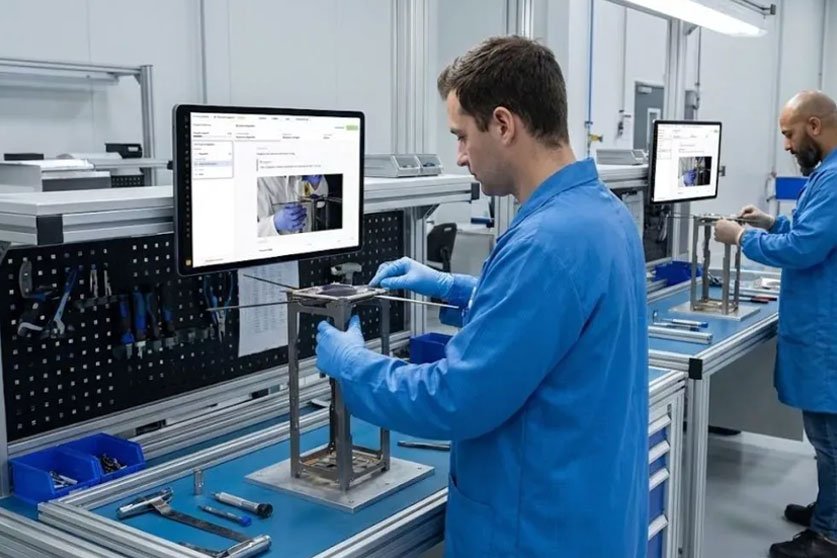
In manufacturing, the most expensive mistakes are often the smallest ones. A step skipped under time pressure, a part fitted in the wrong order, or a check rushed at the end of a long shift can quietly turn into rework, scrap, customer complaints or even a product recall.
Standard Operating Procedures exist to prevent exactly these slips. Yet writing a good SOP is only half the job. The harder part is making sure it is followed every time, by every operator, on every unit. For years, SOP monitoring has meant supervisors on the floor, periodic audits and signed checklists, methods that tell you about a problem only after it has already happened.
That is changing. With camera-based AI that can recognise each step of a process as it unfolds, manufacturers no longer have to wait for audits or end-of-line inspection to discover a deviation. They can spot it the moment it occurs and correct it before the product moves on.
In this article, we look at how factories are moving from SOP monitoring to real-time error prevention, how the technology works, where it adds the most value and how to get started.
From Monitoring to Prevention: What Changes
Traditional SOP monitoring relies on supervisors, spot audits and checklists. It is reactive, because checks happen after a step, shift or batch is complete. It is selective, because no one can watch every station all day. And it depends on self-reporting, where a ticked box proves little about how the work was actually done.
Real-time error prevention flips this approach. Instead of asking whether the SOP was followed, it checks whether it is being followed right now, and alerts the operator within seconds when a step drifts. Think of it as AI-powered poka-yoke: mistake-proofing extended to manual tasks that fixtures and sensors cannot easily cover.
How AI-Based SOP Error Prevention Works
Modern AI-based SOP error prevention systems compare what is happening against a digital version of the SOP and respond the moment the two diverge. A typical setup follows five stages.
- Integration. Industrial or existing CCTV cameras are positioned to cover the key workstations, machines and handling areas. Video streams are processed in real time, often at the edge, close to the line.
- SOP modelling. Each procedure is broken down into observable steps: picking a part, placing it, fastening it, inspecting it, moving it on. The AI is trained to recognise these actions, their order and their expected outcomes.
- Continuous monitoring. The system tracks both operator and machine activity across every cycle, not just a sample. It checks whether steps occur, whether they occur in the right sequence, and whether the result matches what is expected.
- Instant alerts. When a step is skipped, repeated, performed out of order or produces an abnormal result, an alert is raised immediately on a screen, a light tower, a mobile device or the line supervisor’s dashboard.
- Reporting and insight. Every cycle is logged, building a detailed record of compliance, deviations and corrective actions. Over time, this data reveals which steps, shifts or stations cause the most trouble.
The key shift is in stage four. Feedback arrives while the operator is still at the station, so the error can be fixed in seconds instead of being found hours later in final inspection or, worse, by a customer.
Where Real-Time Prevention Makes the Biggest Difference
Any process with repeatable manual steps can benefit, but some environments see especially strong returns.
- Electronics and PCB assembly: verifying that components are placed in the right order and orientation, and that ESD and handling procedures are followed.
- Automotive manufacturing: confirming torque sequences, fastener counts and sub-assembly steps, where a single missed action can trigger a costly recall.
- Pharmaceuticals and medical devices: enforcing gowning, line clearance, cleaning and packaging procedures in tightly regulated environments where documented compliance is mandatory.
- Food and beverage: checking hygiene steps, handwashing, and correct handling at critical control points.
- Warehousing and logistics: ensuring correct picking, packing, labelling and dispatch, so the right product reaches the right customer.
In each case, the value comes from two sources: fewer defects reaching the next stage, and a reliable, timestamped record that proves the procedure was followed.
The Business Benefits
Lower cost of quality. Catching an error at the station is far cheaper than scrapping a finished unit, reworking an assembly or handling a field failure. Prevention moves quality costs upstream, where they are smallest.
Stronger compliance and audit readiness. Instead of relying on signed checklists, manufacturers have objective, video-backed evidence for every cycle. That makes internal audits, customer audits and regulatory inspections faster and less stressful.
Higher productivity. Automated monitoring frees supervisors and quality staff from repetitive observation. They can focus on root-cause analysis, training and improvement work that machines cannot do.
Faster operator learning. Immediate feedback works as on-the-job coaching. New operators learn the correct sequence quickly, and experienced operators are reminded before small shortcuts become habits.
Continuous improvement backed by data. Deviation patterns show which SOPs are unclear, which stations are poorly designed and which shifts need support. Process engineers can fix the cause, not just the symptom.
Importantly, the aim is not to police workers. Well-implemented systems support operators by making the right way the easy way, and many plants find that a clear, consistent feedback loop reduces frustration on the line.
Making the Move: A Practical Roadmap
Shifting from monitoring to prevention does not require replacing everything at once. A phased approach reduces risk and builds confidence.
- Pick a high-impact process. Start with a station where deviations are frequent, expensive or compliance-critical. A clear business case makes the pilot easier to measure.
- Clean up the SOP first. AI can only enforce what is clearly defined. Review the procedure, remove ambiguity and make sure every step is observable on camera.
- Design the alert workflow. Decide who gets notified, how and what they should do. An alert that nobody acts on is just another report.
- Involve operators early. Explain what the system watches and why. Operators who understand the purpose are more likely to trust the feedback and suggest improvements.
- Measure, then scale. Track deviation rates, rework, first-pass yield and audit findings before and after the pilot. Use the results to prioritise the next lines and processes.
The move from SOP monitoring to real-time error prevention is not just a technology upgrade. It is a change in mindset, from finding mistakes to stopping them. For manufacturers facing tighter margins, stricter regulations and rising customer expectations, it is quickly becoming the new standard for operational excellence.















Leave a Reply