
Introduction
Small businesses increasingly depend on digital software to manage financial operations employee records payrolland regulatory responsibilities.
Accounting and human resource management systems have become essential tools for improving efficiency reducing administrative workloads and maintaining accurate business records.
However adopting these technologies also introduces important challenges related to cybersecurity, data privacy regulatory compliance and system integration.
Choosing the right software is not simply about comparing features or subscription prices. Business owners must understand how these platforms store information control access, protect sensitive records and maintain compliance with applicable regulations.
A well-designed software architecture can help small businesses build secure, scalable, and reliable operations without requiring the resources of a large enterprise.
Understanding Small Business Accounting Software Architecture
Accounting software serves as the foundation of financial management for many small organizations.
It handles transactions, invoices, expense tracking, payroll-related financial records, tax calculations, and financial reporting.
Behind these features is a technical architecture that determines how financial information is collected processed stored and accessed. Modern accounting platforms commonly use cloud-based infrastructure, encrypted databases, application programming interfaces APIs and automated backup systems.
When evaluating accounting platforms, businesses should consider several architectural components:
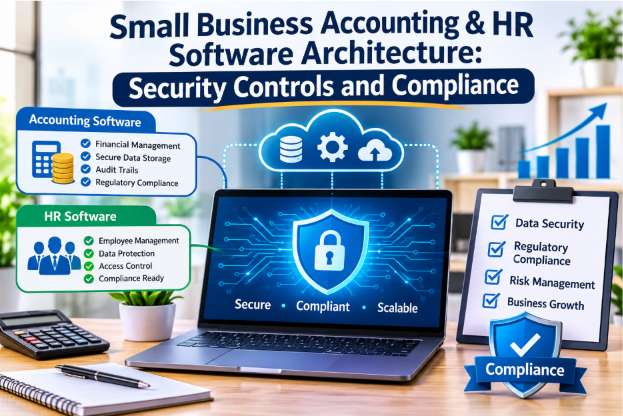
- Data storage: Financial records should be stored in secure databases with appropriate encryption and backup procedures.
- Access management: Role-based permissions help ensure that employees can only access information required for their responsibilities.
- Data encryption: Sensitive financial information should be protected during transmission and while stored.
- System integration: Secure APIs allow accounting software to communicate with banking platforms, payment processors, and other business applications.
- Audit trails: Detailed activity records help identify unauthorized changes and support financial accountability.
Understanding these technical requirements makes it easier to select reliable platforms. Businesses can explore this business accounting software technical architecture and compliance guide to better understand the security standards and architectural considerations involved in selecting accounting solutions.
Essential Security Controls for Financial Information
Financial data is among the most sensitive information maintained by a business. Unauthorized access accidental deletion ransomware or compromised employee credentials can create significant financial and operational consequences.
Small businesses should implement multiple layers of security rather than depending on a single protection mechanism.
1. Multi-Factor Authentication
Multi-factor authentication MFA adds another verification step beyond a username and password. Even if login credentials are compromised additional authentication requirements can make unauthorized access more difficult.
2. Role-Based Access Control
Not every employee needs access to complete financial records. Role-based access control allows administrators to assign permissions according to job responsibilities. For example, an accounts assistant may need access to invoices but not confidential executive financial reports.
3. Regular Data Backups
Automated backups help organizations recover important information after technical failures, accidental deletion, or cyberattacks. Businesses should maintain protected backup copies and periodically test their recovery procedures.
4. Audit Logging and Monitoring
Audit logs record important activities, including financial adjustments, account access, and changes to sensitive records. Monitoring these activities helps organizations detect suspicious behavior and investigate potential security incidents.
The Role of HR Software in Small Business Operations
Human resource management software plays an equally important role in modern business architecture. It helps organizations manage employee information, recruitment, attendance, payroll, performance evaluations, leave requests, and workplace documentation.
Unlike general business applications, HR platforms frequently process highly confidential employee information. This may include identification documents, employment contracts, compensation details, bank information, and performance records.
Therefore, security and compliance must be central considerations when selecting an HR solution.
A reliable HR platform should provide secure employee record management, controlled access permissions, encryption, activity monitoring, and appropriate data retention policies.
HR Software Security and Regulatory Compliance
HR compliance involves more than maintaining employee documents. Organizations must also understand how personal information is collected, processed, stored, shared, and eventually deleted.
The applicable requirements depend on the organization’s location, workforce, and business activities. Depending on the circumstances, regulations such as GDPR and other national or regional employment and data protection laws may apply.
Small businesses should evaluate HR platforms using the following criteria:
Employee Data Protection: Sensitive employee information should be protected through encryption, secure storage, and restricted access.
Permission Management: HR administrators, managers, and employees should have clearly defined access privileges.
Document Security: Employment contracts, payroll statements, and identification records should be stored in controlled environments.
Data Retention: Businesses should establish policies for retaining and deleting employee information according to applicable legal requirements.
Compliance Reporting: HR systems should make it easier to retrieve records and demonstrate compliance during internal reviews or regulatory inspections.
Selecting a platform requires careful technical and operational evaluation. This HR management software security controls and compliance guide provides additional insight into evaluating HR platforms regulatory responsibilitiesband essential protection mechanisms.
Integrating Accounting and HR Systems Securely
Although accounting and HR software perform different functions integrating them can improve operational efficiency.
For example payroll information generated through an HR platform may need to be transferred into an accounting system for financial reporting.
Automated integration can reduce manual data entry, minimize errors, and improve consistency across business records.
However, integration also creates potential security risks if information is transferred without proper controls.
Businesses should consider these practices:
- Use authenticated and encrypted APIs for system communication.
- Limit integration permissions to the information actually required.
- Monitor automated data transfers and record significant activities.
- Review third-party applications before granting access to business systems.
- Maintain separate administrative accounts and access credentials.
- Test integrations regularly to identify configuration weaknesses.
A secure integration strategy should balance operational convenience with the principle of least privilege.
Cloud Security and Third-Party Vendor Evaluation
Many small businesses prefer cloud-based accounting and HR platforms because they reduce infrastructure costs and provide remote access. Howeverbcloud adoption does not eliminate the responsibility to evaluate software providers.
Before selecting a vendor, businesses should investigate its security practices data hosting arrangementsb incident response procedures, backup policies, and service availability commitments.
Important questions include:
- Does the provider encrypt sensitive information?
- Does the platform support multi-factor authentication?
- Can administrators review access logs?
- How frequently are backups performed?
- Does the vendor have a documented incident response process?
- Can business data be exported when changing providers?
- Are independent security assessments or relevant certifications available?
Vendor transparency is particularly important for small organizations that may not have dedicated cybersecurity teams.
Building a Scalable Software Architecture
Business requirements change as organizations grow. A company that initially employs five people may eventually manage multiple departments, larger payroll operations, and more complex financial reporting requirements.
Software architecture should therefore support future expansion.
Scalable platforms should offer flexible user permissionsbreliable APIsbconfigurable reporting, secure data migration and integration capabilities. Businesses should also avoid purchasing unnecessary software features that increase costs and create additional security responsibilities.
A practical approach is to identify current operational requirements, establish minimum security standards, and select systems that can accommodate future growth without requiring a complete technology replacement.
Conclusion
Accounting and HR software are critical components of a modern small business technology environment. While these systems improve financial management and employee administration, they also handle sensitive information that requires strong protection.
Businesses should evaluate software architecture, encryption, authentication, access management, audit logging, backup procedures, vendor security, and regulatory responsibilities before making purchasing decisions.
By treating security and compliance as essential parts of software selection rather than optional features, small businesses can reduce operational risks, protect confidential information, and establish a reliable technology foundation for long-term growth.















Leave a Reply