
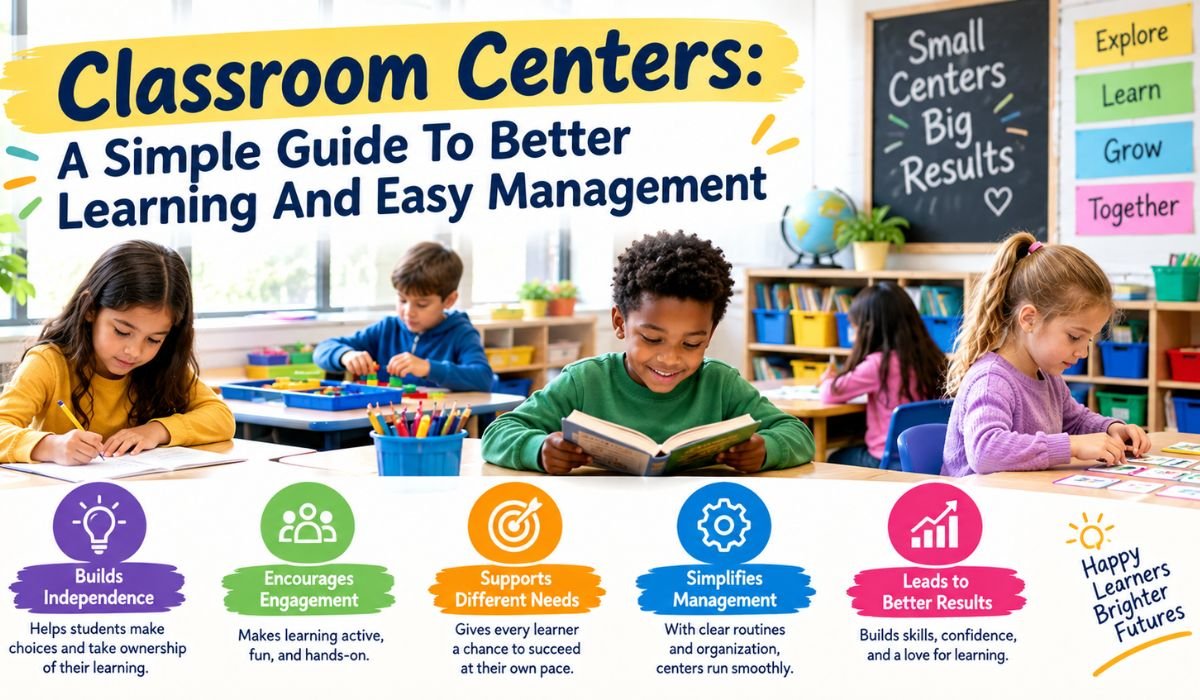
A Well-Organized Classroom Can Make A Big Difference In How Children Learn, Explore, And Build Confidence. One Practical Way To Create An Active And Enjoyable Learning Environment Is By Using A Classroom Center. Classroom Centers Give Students Different Places To Practice Skills, Explore Ideas, Read Books, Solve Problems, And Learn Through Hands-On Activities.
Instead Of Asking Every Student To Complete The Same Task At The Same Time, Teachers Can Create Small Learning Areas With Different Activities. Children Might Practice Letter Sounds At A Literacy Table, Count Objects At A Math Station, Explore Materials In A Sensory Area, Or Enjoy Independent Reading In A Classroom Library. Each Center Has A Purpose, But Students Can Experience Learning In Different Ways.
Classroom Centers Are Especially Useful In Kindergarten And Early Elementary Grades, Where Children Benefit From Movement, Visual Materials, Repetition, And Guided Independence. However, They Can Also Work Well In Older Classrooms When Activities Match Students’ Ages And Learning Goals.
The Key To Successful Classroom Center Management Is Not Filling Every Corner With Supplies. It Is Creating A Clear System That Helps Students Understand What To Do, How To Use Materials, And How To Work With Less Teacher Assistance. With Thoughtful Planning, Classroom Centers Can Support Academic Growth, Encourage Responsibility, And Make Daily Teaching More Manageable.
Quick Bio Information
| Category | Information |
|---|---|
| Topic | Classroom Center |
| Main Purpose | Organized, Active Learning |
| Primary Audience | Teachers And Educators |
| Common Grade Levels | Kindergarten And Early Elementary |
| Learning Approach | Hands-On And Student-Centered Practice |
| Core Principles | Choice, Structure, And Independence |
| Main Subjects | Literacy, Mathematics, Science, And Art |
| Management Tool | Visual Center Display Or Choice Wheel |
| Example Grouping | Color-Coded Student Groups |
| Typical Activity Format | Matching, Sorting, Puzzles, And Games |
| Literacy Skills | Phonics, Reading, Spelling, And Writing |
| Math Skills | Counting, Number Sense, And Graphing |
| Differentiation | Activities Matched To Learning Needs |
| Teacher’s Role | Guide, Observe, Assess, And Support |
| Student’s Role | Choose, Practice, Collaborate, And Clean Up |
| Assessment Methods | Observation, Student Work, And Brief Checks |
| Early Finisher Strategy | Meaningful Independent Activities |
| Organization Tools | Baskets, Tubs, Labels, And Visual Instructions |
| Planning Strategy | Reuse Familiar Formats And Update Content |
| Long-Term Goal | Confident, Purposeful, Independent Learning |
What Are Classroom Centers?
Classroom Centers Are Organized Learning Areas Where Students Complete Activities Focused On Particular Subjects, Skills, Or Learning Goals. Each Area Usually Contains Materials, Tools, And Instructions That Help Children Work Independently, With A Partner, Or In A Small Group. A Classroom Center Might Focus On Reading, Writing, Mathematics, Science, Art, Building, Or Sensory Exploration.
For Example, A Literacy Center May Include Alphabet Cards, Picture-Word Matching Games, Letter Tiles, And Simple Reading Activities. A Math Center Might Offer Counting Objects, Number Puzzles, Ten Frames, And Pattern Games. Teachers Choose Activities According To Their Curriculum And Students’ Developmental Needs.
Unlike A Traditional Lesson In Which The Whole Class Follows One Task, Learning Centers Allow Children To Practice Skills Through Different Experiences. Some Students May Work With Physical Objects, While Others Read, Write, Draw, Or Solve Problems. The Teacher Still Guides Learning, But Students Have More Opportunities To Participate Actively And Make Decisions.
Why Classroom Centers Matter
Classroom Centers Can Make Learning More Active And Meaningful Because Children Have Opportunities To Handle Materials, Test Ideas, And Practice Skills Rather Than Only Listening To Instructions. A Child Learning To Count, For Instance, May Understand Quantities More Clearly By Moving Counters Into Groups Than By Looking At Numbers Alone.
Centers Also Give Students Repeated Practice. Early Reading And Mathematics Skills Often Develop Through Short, Regular Activities That Build On Previous Knowledge. A Well-Planned Center Lets Children Repeat A Familiar Game While Practicing A New Letter Sound, Number, Or Word.
Another Benefit Is That Centers Can Support Different Learning Needs. Some Children May Need More Time With Basic Skills, While Others Are Ready For A Greater Challenge. Teachers Can Prepare Activities At Different Levels Without Requiring Every Student To Complete Identical Work.
Centers May Also Encourage Communication, Cooperation, Creativity, And Problem-Solving. These Benefits Depend On How Activities Are Designed And Taught, So Teachers Should Observe Students And Adjust Their Approach When Necessary.
How To Set Up Classroom Centers
Setting Up Classroom Centers Starts With Clear Learning Goals. Before Buying Supplies Or Rearranging Furniture, Decide Which Skills Students Need To Practice And Which Activities Will Help Them Reach Those Goals. This Makes The Classroom More Purposeful And Helps Prevent Materials From Becoming Decorations That Children Rarely Use.
Next, Consider The Available Space. Centers Do Not Need Large Tables Or Separate Rooms. A Small Shelf, A Corner With Floor Cushions, A Table With Organized Trays, Or A Clearly Marked Area Can Be Enough. Keep Walkways Open So Students Can Move Safely Between Activities.
Place Frequently Used Materials Where Children Can Reach Them Without Climbing Or Asking For Help. Use Labeled Containers, Picture Instructions, And Simple Storage Systems To Make Cleanup Easier. Consider Noise Levels, Visibility, Accessibility, And The Teacher’s Ability To Supervise Different Areas.
Start With A Manageable Number Of Centers And Add More As Students Become Familiar With The Routine. A Few Well-Prepared Activities Are Usually More Effective Than Many Disorganized Stations. Review The Setup Regularly To Make Sure Each Center Still Supports Current Learning Goals.
Using A Classroom Center Management System
A Classroom Center Management System Helps Students Understand Where They Can Work And What They Are Expected To Do. One Approach Described By Kindergarten Educator Greg Smedley-Warren Uses A Color-Coded Center Wheel. Each Student Group Has A Color, And The Wheel Shows Two Center Options Available To That Group.
For Example, A Student In The Pink Group Might Choose Between Literacy Tubs And The Classroom Library. After Completing An Activity, The Student Can Continue With Another Suitable Task Or Move To The Other Permitted Center. Matching Colors On The Wheel, Storage Baskets, And Activity Materials Makes The System Easier For Young Children To Follow.
Teachers Can Adapt This Idea To Suit Their Class Size And Available Resources. Some May Prefer Picture Cards, Name Tags, Pocket Charts, Or Digital Displays. The Important Thing Is That Students Can Quickly See Their Options Without Depending On Constant Verbal Reminders.
A Visual System Does Not Need To Be Complicated. It Should Be Easy To Understand, Simple To Update, And Flexible Enough To Reflect Changes In Student Skills. When Students Know How The System Works, Teachers Can Spend More Time Teaching And Less Time Managing Routine Questions.
Establishing Classroom Center Rules
Clear Rules Help Classroom Centers Remain Productive And Safe. Students Need To Understand How To Choose An Activity, Handle Materials, Work With Others, Ask For Assistance, And Return Supplies When They Finish. These Expectations Should Be Demonstrated And Practiced Before Children Are Expected To Follow Them Independently.
A Useful Routine Begins With Checking For Unfinished Work, Looking At The Center Display, Selecting An Approved Activity, And Completing It Before Moving To Another Task. Teachers Can Use Picture Sequences To Remind Younger Children Of Each Step. A Consistent Routine Makes Transitions Easier To Manage And Helps Children Develop Responsibility.
Rules Should Also Explain Appropriate Noise Levels And How Students Should Respond When Materials Are Missing Or Another Child Is Using Something They Need. Instead Of Assuming That Children Know What Cooperation Looks Like, Teachers Can Model Sharing, Taking Turns, Solving Small Problems, And Asking For Help Politely.
Practice These Procedures During Short Sessions Before Introducing Longer Periods Of Independent Work. Praise Specific Behaviors, Such As Returning Materials Correctly Or Finishing A Task Without Repeated Reminders. When A Routine Breaks Down, Identify The Cause And Reteach The Relevant Skill Rather Than Simply Adding More Rules.
Literacy Centers For Kindergarten
Literacy Centers Give Children Opportunities To Develop Early Reading And Writing Skills Through Practical Activities. Common Options Include Alphabet Matching, Letter-Sound Games, Picture Sorting, Word Building, Sight-Word Practice, Sentence Construction, And Independent Reading. The Best Activities Match The Skills Students Are Currently Learning In Class.
Phonics Activities Can Help Children Connect Letters With Their Sounds. For Example, Students Might Match A Letter Card With Pictures Beginning With The Same Sound. Children Practicing Simple Consonant-Vowel-Consonant Words Can Arrange Letter Tiles To Build Words Such As “Cat” Or “Sun,” Then Read The Words Aloud.
Write-The-Room Activities Encourage Students To Move Around The Classroom, Find Displayed Words Or Pictures, And Record Their Answers. A Classroom Library Provides A Quieter Option Where Children Can Explore Age-Appropriate Books And Practice Reading Behaviors.
Teachers Should Make Sure Activities Have Clear Instructions And A Suitable Level Of Difficulty. Repeating A Familiar Game With New Letters Or Words Can Keep The Format Predictable While Developing Different Skills. Independent Centers Should Complement, Not Replace, Explicit Reading Instruction And Teacher Feedback.
Math Centers For Kindergarten
Math Centers Help Children Explore Numbers, Shapes, Patterns, Counting, Comparing, And Early Arithmetic Through Hands-On Learning. Instead Of Only Completing Worksheets, Students Can Use Counters, Dice, Number Cards, Building Blocks, And Other Manipulatives To Represent Mathematical Ideas.
Ten Frames Are One Useful Tool For Early Mathematics. These Arrangements Of Ten Spaces Help Children See How Many Objects Are Present And How Numbers Relate To Five And Ten. Students Can Place Counters In The Frames, Compare Different Quantities, And Gradually Explore Simple Addition And Subtraction.
Count-The-Room Activities Ask Students To Count Objects Or Pictures Placed Around The Classroom And Record Their Answers. Teachers Can Prepare Different Recording Sheets To Match Student Needs, Such As Counting Up To 10, 15, Or 20. As Skills Develop, Similar Activities Can Include Simple Addition Or Subtraction.
Graphing Centers Offer Another Practical Way To Explore Mathematics. Children Can Count Objects, Sort Information Into Categories, Create Picture Graphs, And Discuss Which Category Has More Or Fewer Items. These Activities Introduce Data Skills While Giving Students Opportunities To Explain Their Thinking.
Sensory, Science, And Creative Centers
Sensory Centers Give Children Opportunities To Explore Materials Through Touch, Movement, Observation, And Manipulation. Depending On The Learning Goal, A Sensory Bin Might Contain Suitable Objects For Sorting, Counting, Matching, Or Comparing. A Light Table Can Be Used With Appropriate Translucent Materials To Explore Colors, Shapes, Patterns, And Visual Relationships.
Science Centers Can Encourage Children To Observe Plants, Compare Natural Objects, Explore Magnets, Or Investigate How Materials Behave. Simple Activities Can Begin With Questions Such As What Floats, What Sinks, Or Which Objects Are Attracted To A Magnet. Teachers Should Choose Safe Materials And Explain How To Handle Them.
Creative Centers May Include Drawing, Painting, Construction, Collage, Or Model-Making. These Activities Can support Fine Motor Development, Imagination, And Communication When Children Explain Their Designs Or Choices. Art Should Not Always Require Every Child To Produce The Same Result; Open-Ended Tasks Allow Different Ideas To Emerge.
Safety And Supervision Are Essential. Avoid Materials That Present Choking, Allergy, Or Other Hazards For The Children In Your Care. Establish Clear Rules About Handling Supplies, Cleaning Up, And Keeping Materials Away From Mouths And Eyes. Sensory And Creative Activities Should Have A Clear Purpose While Leaving Room For Exploration.
Differentiating Classroom Center Activities
Differentiation Means Adjusting Activities To Reflect Students’ Current Skills, Learning Needs, And Readiness. A Single Center Can Often Support Several Levels Without Changing Its Basic Format. For Example, One Group May Match Numerals To Quantities Up To Five, While Another Works With Numbers Up To Ten Or Twenty.
Teachers Can Use Observations, Classwork, Brief Assessments, And Student Responses To Decide Which Skills Need More Practice. Color-Coded Materials Can Help Children Find Appropriate Activities, But Colors Should Remain Organizational Tools Rather Than Permanent Labels Of Ability.
Flexible Grouping Allows Teachers To Change Student Assignments As Skills Develop. A Child Who Needs Support With Letter Sounds Today May Be Ready For Word-Building Activities Later. Teachers Should Review Progress Regularly And Adjust Materials Instead Of Keeping Students In Fixed Groups Without Considering Their Growth.
Accessibility Also Matters. Some Students May Benefit From Picture Instructions, Larger Materials, Fewer Steps, Extra Time, Or Alternative Ways To Respond. Others May Need More Challenging questions or activities that encourage deeper thinking. The Goal Is To Make Learning Achievable While Maintaining Meaningful Expectations For Every Student.
Managing Small Groups During Center Time
One Of The Greatest Advantages Of Well-Organized Classroom Centers Is That They Can Give Teachers Time To Work With Small Groups. While Other Children Complete Familiar Activities, The Teacher Can Focus On A Particular Skill With A Few Students At A Time.
These Groups Should Reflect Learning Needs Rather Than Simply Following Permanent Seating Arrangements. A Teacher Might Work With One Group On Blending Sounds, Another On Reading Simple Words, And Another On Counting Or Number Combinations. The Specific Focus Depends On Assessment Information And Current Curriculum Goals.
A Successful Small-Group Lesson Needs A Clear Objective And Activities That Allow The Teacher To Observe Student Thinking. Brief Modeling, Guided Practice, Questions, And Immediate Feedback can help students understand a skill more clearly. Afterward, Students Return To Their Independent Activity When They Know What To Do Next.
Independent Centers Must Be Familiar Enough that children can continue working without frequent interruptions. Teachers should introduce activities before expecting students to manage them alone and provide a simple way to request assistance. This balance allows targeted instruction and independent practice to happen during the same learning period.
Keeping Students Engaged And Independent
Engagement Comes From More Than Bright Colors Or Attractive Materials. Students are more likely to stay involved when activities are understandable, appropriately challenging, and connected to skills they are learning. Giving children a choice between suitable activities can also increase their sense of ownership.
A useful approach is to teach the activity format first and introduce new academic content within that familiar format. Students might learn how to play a matching game with colors before using the same rules to match letters, sounds, or numbers. Familiar procedures reduce confusion and help children begin work more confidently.
Allowing students to work alone or with a partner can offer flexibility, provided both options suit the task. Teachers should observe whether children are genuinely practicing the intended skill or simply moving materials around. If an activity is too easy, too difficult, or unclear, adjust it.
Independence does not mean leaving children without support. It means gradually teaching them how to begin, make decisions, manage materials, solve simple problems, and recognize when they need help. Short instructions, visual reminders, and regular feedback can strengthen these habits over time.
Helping Early Finishers Stay Productive
Early Finishers Often Create A Challenge When Some Children Complete Their Work Before Others. Classroom Centers Can Offer A Practical Solution By Keeping Appropriate Learning Activities Available After Assigned Work Is Finished.
Students Might Choose A Puzzle, Read A Book, Practice A Familiar Phonics Game, Build Numbers With Counters, Or Complete A Sorting Activity. These Options Provide Meaningful Practice Without Requiring Teachers To Prepare A New Worksheet Every Time Someone Finishes Early.
Teachers Should Explain When Students May Move To A Center And Which Options Are Available. If Unfinished Work Must Be Completed First, That Expectation Should Be Clear. Activities Should Also Be Designed So Children Can Start Them Safely And Understand What Completion Looks Like.
Not Every Early Finisher Needs More Academic Work. Quiet Reading, Creative Exploration, And Constructive Play Can Also Be Valuable When They Fit Classroom Goals. The Aim Is To Provide Purposeful Choices Rather Than Treating Speed As A Reason To Give Students Endless Additional Assignments.
Organizing Materials And Saving Preparation Time
Classroom Center Management Becomes Easier When Materials Are Simple To Store, Find, And Replace. Clear Containers, Picture Labels, Color-Coded Baskets, And Consistent Storage Locations Help Students return items without waiting for the teacher. Keep Frequently Used Materials Within Safe Reach And Store Less Common Supplies Separately.
Reusable Activity Formats Can Also Reduce Planning Time. Matching Games, Puzzles, Spinners, Clip Games, And Sorting Activities Can Be Adapted To Different Topics Throughout The Year. The Procedure Stays Familiar, While The Content Changes To Match Current Lessons.
Teachers Do Not Need To Replace Every Center Each Week. Keeping Activities Available For Several Weeks Can Give Children Time To Practice And Explore Different Options. Change Materials When Students Need A New Challenge, When A Skill Has Been Mastered, Or When An Activity No Longer Supports Current Learning Goals.
A Simple Review Routine Can Help Maintain Quality. Check Whether Materials Are Complete, Instructions Remain Clear, And Activities Are Still Appropriate. Remove Broken Supplies, replace worn materials, and update tasks based on student progress. Small, regular adjustments are often easier than rebuilding the entire classroom system.
Common Classroom Center Management Mistakes
One Common Mistake Is Introducing Too Many Activities Before Students Understand The Basic Routine. An Overloaded Classroom Can Create Confusion, Make Cleanup Difficult, And Increase The Number Of Questions Children Ask. Starting With A Few Centers And Teaching Their Procedures Carefully Creates A Stronger Foundation.
Another Problem Is Choosing Activities Mainly Because They Look Attractive. Materials Should Support A Specific Learning Goal And Offer An Appropriate Level Of Challenge. Teachers should also avoid assuming that every student will automatically know how to share, transition, or use a game independently.
Rigid Grouping Can Limit Progress When Students’ Skills Change. Review Learning Evidence And Adjust Activities Or Groups When Needed. Similarly, Avoid Treating Color-Coded Groups As Fixed Ability Categories; Their purpose is to organize access, not to define a child’s potential.
Finally, Avoid Measuring Success Only By Whether Children Finish a task. Observe their understanding, listen to their explanations, and review their work. If an activity causes repeated confusion or fails to provide useful practice, revise it. Effective center management depends on thoughtful teaching, ongoing observation, and a willingness to make improvements.
Adapting Classroom Centers For Different Classrooms
Classroom Centers Can Work In Different School Settings, But The System Should Reflect Available Space, Class Size, Student Ages, And Learning Goals. A Large Kindergarten Classroom May Support Several Distinct Areas, While A Smaller Room May Need Portable Tubs That Can Be Used At Shared Tables And Stored On Shelves.
Teachers With Limited Budgets Can Create Effective Activities Using Everyday Supplies Such As Paper, Reusable Cards, Blocks, Counters, Picture Books, And Recycled Materials That Are Safe For Classroom Use. Expensive Equipment Is Not Necessary For Every Center. Clear Instructions And Purposeful Activities Matter More Than Elaborate Decorations.
Digital Activities Can Supplement Classroom Learning When Devices And Appropriate Software Are Available. However, Screen-Based Tasks Should Have A Clear Educational Purpose And Should Not Replace Valuable Opportunities For Conversation, Reading, Physical Manipulation, Or Direct Teacher Instruction. Teachers Should Also Consider Privacy, Accessibility, And School Technology Policies.
For Older Students, Centers Can Include Writing Workshops, Science Investigations, Research Tasks, Collaborative Problem-Solving, And Subject-Specific Practice. The Materials And Level Of Independence Will Change, But The Underlying Principles Remain Similar: Clear Goals, Organized Resources, Meaningful Choices, And Appropriate Support. Teachers Can Start Small, Observe What Works, And Gradually Build A System That Fits Their Students.
Conclusion: Final Thoughts
Classroom Centers Can Turn An Ordinary Classroom Into A More Flexible And Engaging Learning Environment. When Children Have Clear Instructions, Well-Organized Materials, And Appropriate Choices, They Can Practice Important Skills While Developing Responsibility And Confidence.
The Most Effective System Does Not Need To Be Expensive Or Complicated. A Few Carefully Planned Literacy, Math, Science, Or Creative Centers Can Provide Valuable Learning Opportunities When They Match Students’ Needs And Fit The Classroom Routine. Visual Guides, Consistent Expectations, And Familiar Activity Formats Help Children Understand What To Do Without Relying On Constant Teacher Direction.
Teachers Should Also Remember That Independence Develops Gradually. Students Need Modeling, Practice, Feedback, And Opportunities To Learn From Mistakes. Observing Their Progress And Adjusting Activities Makes Classroom Centers More Useful Over Time.
Ultimately, Successful Classroom Center Management Is About Finding The Right Balance Between Structure And Choice. With Purposeful Activities And Thoughtful Guidance, Teachers Can Create Learning Spaces Where Children Explore Ideas, Practice Skills, Work With Others, And Become More Confident Learners.
FAQs About Classroom Centers
What Is A Classroom Center?
A Classroom Center Is An Organized Learning Area Where Students Complete Activities Focused On A Particular Subject Or Skill. Examples Include Literacy, Math, Science, Art, And Sensory Centers. Each Area Provides Materials And Instructions That Help Students Practice Skills Through Independent Work, Partner Activities, Or Small-Group Learning.
Why Are Classroom Centers Important?
Classroom Centers Give Students Opportunities To Practice Skills, Explore Materials, And Make Decisions During Learning. They Can Support Engagement, Cooperation, Problem-Solving, And Differentiated Instruction. Their Effectiveness Depends On Thoughtful Activity Design, Clear Expectations, Teacher Guidance, And Regular Checks Of Student Understanding.
How Many Classroom Centers Should A Teacher Have?
There Is No Single Correct Number. The Best Number Depends On Classroom Space, Class Size, Available Materials, And Student Readiness. Teachers Can Start With Two Or Three Well-Organized Centers And Introduce More As Children Learn The Routines. A Smaller Number Of Effective Centers Is Often Easier To Manage Than Many Poorly Prepared Ones.
What Are The Best Classroom Centers For Kindergarten?
Useful Kindergarten Centers Include Literacy Tubs, Classroom Libraries, Alphabet Games, Counting Activities, Ten Frames, Puzzles, Sensory Exploration, And Simple Science Tasks. Teachers Should Choose Activities That Match Current Learning Goals And Offer Appropriate Levels Of Challenge. The Best Selection Will Vary With Students’ Needs And The Curriculum.
How Can Teachers Manage Classroom Centers Effectively?
Teachers Can Use Visual Displays, Clear Rules, Organized Materials, Picture Instructions, And Consistent Routines. Students should know how to choose an activity, complete it, request help, and return supplies. Practicing these procedures before expecting independent work can reduce confusion and make center time more productive.
How Do Classroom Centers Support Different Learning Needs?
Teachers Can Prepare Activities With Different Levels Of Difficulty, Adjust Instructions, Offer Accessible Materials, And Change Student Groups As Skills Develop. For Example, Students May Practice Counting Different Quantities Or Build Words At Different Levels. Regular Observation Helps Teachers Decide Whether Children Need More Support Or A Greater Challenge.
How Can Classroom Centers Help Early Finishers?
Classroom Centers Give Students Meaningful Activities To Choose After Completing Assigned Work. Suitable Options May Include Independent Reading, Puzzles, Phonics Games, Number Activities, Or Sorting Tasks. Teachers Should Explain Which Centers Are Available And Ensure That Students Can Use Them Safely Without Constant Assistance.
Do Classroom Centers Need Expensive Materials?
No. Many Effective Centers Use Affordable Supplies Such As Paper, Picture Cards, Blocks, Counters, Reusable Games, Books, And Safe Recycled Materials. The Most Important Factors Are Clear Learning Goals, Appropriate Activities, Simple Organization, And Consistent Teaching. Expensive Technology And Special Equipment May Be Helpful In Some Classrooms, But They Are Not Essential.
Learn more and explore exciting content on: Arsenal F.C.: History, Trophies, Legendary Players, and Club Legacy







Leave a Reply