
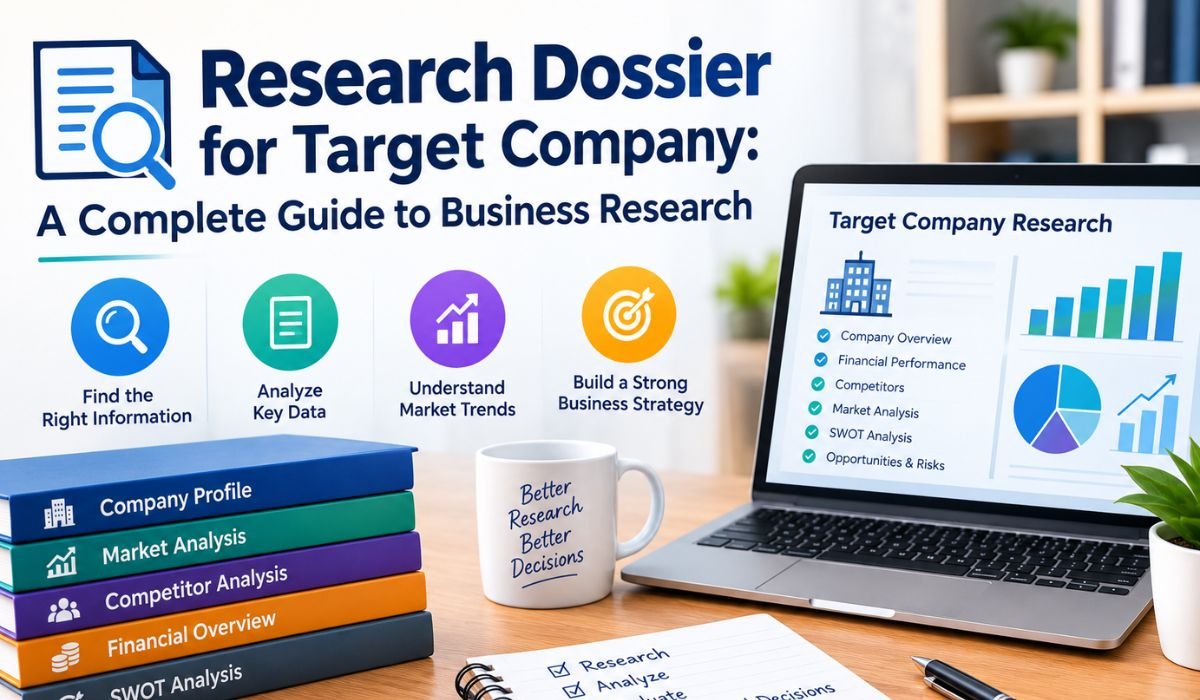
A Research Dossier for Target Company can turn scattered business information into a clear picture of an organization. Whether you are considering an investment, studying a competitor, evaluating a supplier, exploring a partnership, or preparing for an acquisition, good research helps you understand what sits behind a company’s public image. Instead of relying on a website, a few articles, or a single financial figure, a company research dossier brings together evidence about the business, its market, finances, leadership, ownership, technology, reputation, and risks.
The real value of a dossier is not its length. It is the quality of the questions it answers and the reliability of the evidence behind those answers. A useful dossier also makes uncertainty visible. When information cannot be verified, that fact belongs in the report rather than being replaced with an assumption.
What Is A Research Dossier For A Target Company?
A Research Dossier for Target Company is a structured report created to investigate a specific organization before an important business decision. The word “target” simply refers to the company being studied. It could be a public corporation, private business, startup, potential acquisition, supplier, customer, competitor, or prospective strategic partner.
A strong dossier normally combines company background, ownership, business model, financial research, market analysis, competitor research, management information, legal and regulatory findings, technology, intellectual property, reputation, risks, and opportunities. The exact contents depend on the reason for the research. An investor may concentrate on financial performance, while an acquisition team may need much deeper legal, tax, operational, and contractual information.
Why Is A Target Company Research Dossier Important?
Business decisions are often made with incomplete information. A company may describe its products positively, emphasize growth, or promote an attractive market opportunity, but those statements need context. A dossier provides a disciplined way to compare company claims with available evidence.
It can also reveal information gaps that deserve further investigation. For a public company, official filings may provide substantial financial and corporate information. In the United States, for example, Investor.gov explains that Form 10-K provides a comprehensive overview of a public company’s business and financial condition, including audited financial statements, while Form 10-Q provides quarterly information.
Quick Bio Information
| Research Fact | Helpful Information |
|---|---|
| Research Purpose | Understand A Specific Company Before A Business Decision |
| Target Company | The Organization Being Investigated |
| Core Focus | Company, Financial, Market, Competitive, Legal, And Operational Research |
| Ownership Research | Founders, Shareholders, Directors, Parents, And Subsidiaries |
| Business Model | How The Company Creates, Delivers, And Captures Value |
| Financial Research | Revenue, Profitability, Cash Flow, Assets, Liabilities, And Debt |
| Market Research | Industry Size, Demand, Trends, Regulations, And Growth |
| Competitor Research | Direct, Indirect, And Substitute Competitors |
| Leadership Research | Executives, Founders, Directors, Experience, And Changes |
| Legal Research | Litigation, Registration, Licenses, Compliance, And Regulatory Matters |
| Technology Research | Platforms, Infrastructure, Automation, And Innovation |
| Intellectual Property | Patents, Trademarks, Copyrights, And Proprietary Technology |
| Reputation Research | Reviews, News Coverage, Customer Feedback, And Public Discussions |
| Risk Research | Financial, Legal, Market, Operational, Technology, And Reputation Risks |
| Source Verification | Cross-Checking Important Claims Against Reliable Sources |
| Public Company Research | Regulatory Filings And Public Disclosures Can Provide Extensive Evidence |
| Private Company Research | Public Information May Be More Limited |
| AI Assistance | Useful For Organization And Summarization, But Claims Require Verification |
| Due Diligence | A More Formal Investigation Often Used For Major Transactions |
| Updating | Important Findings Should Be Reviewed When Circumstances Change |
Start With The Company Background
Every Company Research Dossier should begin by establishing exactly what business is being investigated. Start with the legal name and trading name, then confirm the company’s official website, headquarters, operating locations, industry, major products, services, customer groups, and geographic markets.
The history can add valuable context. Founding dates, major expansions, acquisitions, product launches, rebranding, leadership changes, and other significant events may explain why the company looks different today than it did several years ago. It is also important to identify parent companies, subsidiaries, and affiliated businesses.
This basic verification step prevents a surprisingly common research problem: mixing information from businesses with similar names. A report is only useful when the underlying identity is correct.
Investigate Ownership And Corporate Structure
Ownership can explain who controls a company, how important decisions are made, and how complicated a potential transaction could become. Research may cover founders, major shareholders, investors, directors, board members, parent companies, subsidiaries, and beneficial ownership where reliable records are available.
For public companies, regulatory disclosures can provide important ownership and governance information. SEC EDGAR records, for example, contain company filings and ownership disclosures for U.S. reporting companies.
Private companies require more caution because ownership information may not be publicly available in the same depth. A professional dossier should clearly state when ownership information is incomplete rather than presenting an assumption as a confirmed fact.
Understand The Business Model
Knowing what a company sells is only the beginning. A good Target Company Research process asks how the company actually makes money and whether that model can support its operations.
Research should consider its main revenue sources, customer segments, pricing approach, sales channels, recurring revenue, licensing arrangements, advertising, major costs, and scalability. A subscription company, for example, may generate recurring revenue, but customer retention and acquisition costs can significantly affect the economics of that model.
The goal is to understand the relationship between customers, products, revenue, expenses, and growth. This helps readers move beyond a simple description of the business and understand how the organization functions commercially.
Conduct A Detailed Financial Analysis
Financial research is central to most business intelligence projects. Depending on the company and available records, a dossier may examine revenue, revenue growth, gross profit, operating profit, net income, cash flow, assets, liabilities, debt, cash reserves, funding history, and valuation information.
Public-company researchers have a particularly useful source in regulatory filings. Investor.gov notes that public companies file annual and quarterly reports and certain current reports, with EDGAR providing access to these filings.
One important lesson is that revenue growth should never be treated as a complete measure of financial strength. Sales can rise while margins decline, debt increases, or operating cash flow weakens. Comparing several reporting periods can therefore provide a much more meaningful picture than quoting one year’s revenue.
Analyze The Market And Industry
A target company does not operate in isolation. Its performance is influenced by customers, competitors, regulations, technology, economic conditions, and broader industry trends.
Market research should therefore examine demand, market segments, industry growth, customer behavior, barriers to entry, emerging technologies, regulatory changes, and potential expansion areas. The goal is not merely to say that an industry is “growing” but to understand what that growth means for the company being investigated.
A business operating in a rapidly changing industry may have attractive opportunities but also face greater uncertainty. A mature industry may offer stability while presenting different competitive pressures. Context makes the company analysis more meaningful.
Research Competitors And The Competitive Landscape
Competitor Analysis shows where a target company sits within its market. Direct competitors may offer similar products to similar customers, while indirect competitors may solve the same problem differently. Substitute products can also affect customer demand.
A useful comparison examines products, pricing, customer groups, geography, distribution, technology, brand reputation, and market position. SWOT analysis can help organize the findings, but the underlying strengths, weaknesses, opportunities, and threats should be supported by evidence.
The purpose is not simply to produce a list of competitors. It is to understand what makes the target company’s position different and which external factors could influence its performance.
Examine Leadership And Management
Leadership research should explain more than who occupies the executive suite. A dossier can examine founders, senior executives, directors, professional backgrounds, relevant industry experience, responsibilities, strategic statements, and major management changes.
Leadership changes need context. An executive departure could be connected to normal succession, expansion, restructuring, or another documented event. It should not automatically be described as evidence of organizational trouble.
This approach keeps the report factual and prevents a common research error: turning an observable event into an unsupported conclusion.
Check Legal And Regulatory Information
Legal research can identify information that may materially affect a company’s operations or a potential transaction. Depending on the assignment, researchers may review corporate registration, licenses, regulatory requirements, court records, litigation, enforcement actions, contracts, intellectual property disputes, tax matters, and insolvency or restructuring information.
Careful wording is especially important here. A lawsuit is not the same thing as a judgment, and an allegation is not the same as a proven violation. The dossier should identify what happened procedurally and what has actually been established.
For broader responsible-business research, the OECD’s guidance uses a risk-based approach to identifying, preventing, mitigating, and addressing adverse impacts across operations, supply chains, and business relationships. Its 2026 Responsible Business Outlook also highlights the continuing importance of responsible-business due diligence across issues such as technology, climate, human rights, labor, consumers, and corporate governance.
Evaluate Customers, Reviews, And Reputation
A company’s own marketing provides only one perspective. Customer reviews, industry publications, reputable news organizations, testimonials, professional forums, and public discussions can add another layer of evidence.
The key is to look for patterns rather than isolated comments. One negative review may simply describe one customer’s experience. Repeated, independently reported concerns may justify closer investigation, but even then the dossier should explain what the available evidence actually establishes.
The same principle applies to media coverage. Factual reporting, commentary, promotional material, and speculation should not be treated as interchangeable sources.
Research Technology And Intellectual Property
Technology can be a major part of a company’s value, especially for software, manufacturing, biotechnology, financial technology, and other innovation-driven businesses. Research may examine digital platforms, infrastructure, automation, research and development, cybersecurity, technology partnerships, and product-development capabilities.
Intellectual property deserves separate attention. WIPO explains that intellectual property includes creations such as inventions, designs, and commercial names and symbols, with legal protection available through mechanisms such as patents, copyright, and trademarks.
Patent research can reveal technical information and the legal status of inventions, while trademark research can help establish how brands and signs are protected.
Cybersecurity also belongs in modern company research. The FTC advises businesses to understand what sensitive information they hold, limit unnecessary collection, protect retained information, and consider security throughout business operations.
Identify Business Risks And Opportunities
Once the core research is complete, the dossier should bring the evidence together into a balanced assessment of risks and opportunities. Risks may involve finances, competition, regulations, litigation, operations, technology, cybersecurity, reputation, supply chains, or management.
Opportunities may include new markets, product expansion, partnerships, technology adoption, customer growth, or operational improvements.
The important distinction is between documented risk and speculation. If a company has publicly disclosed rising debt, that is an evidence-based finding. Saying that the company will fail because of that debt is a prediction and requires much stronger support. A good dossier explains the evidence and leaves unsupported certainty out of the report.
How To Build A Research Dossier
The process works best when it begins with a clear research objective. Decide whether the dossier is being prepared for an investment review, acquisition, competitor study, supplier evaluation, partnership, sales strategy, or another purpose.
Next, verify the company and create research categories. Gather information from official sources, government records, regulatory databases, financial reports, credible news, industry publications, and customer sources. Record publication dates and retain the source behind important claims.
After gathering information, cross-check significant findings. If two sources disagree, investigate why. Differences may result from different reporting periods, definitions, ownership changes, or simple errors. The disagreement itself can become a useful research finding.
Finally, organize the evidence into an executive summary, company profile, ownership and leadership review, business model, financial analysis, market and competitor research, legal review, technology assessment, reputation analysis, risks, opportunities, and open questions.
Public Vs Private Companies
A Company Research Dossier can look very different depending on whether the target is public or private. Public companies generally provide more standardized information because securities laws require ongoing disclosures. In the United States, Form 10-K provides annual business and financial information, Form 10-Q provides quarterly reporting, and Form 8-K covers certain material events.
Private companies may provide less information publicly. Researchers may have to rely more heavily on corporate records, company announcements, industry sources, interviews, customer evidence, and information voluntarily disclosed by the business.
The correct response to missing information is not to guess. A professional dossier should state what could not be verified and explain what additional evidence would be useful.
Common Mistakes To Avoid
Poor company research often results from using outdated information, relying on a single source, confusing similarly named businesses, copying unverified claims, or collecting large amounts of irrelevant material.
Another frequent mistake is presenting positive information while ignoring negative findings. A useful dossier should reflect the available evidence in both directions. It should also distinguish documented facts from interpretations and future assumptions.
Finally, the dossier should have a clear research date. Companies change. Leadership, ownership, financial performance, regulations, products, competitors, and strategies can all evolve. A report that was accurate last year may not accurately describe the company today.
Can AI Help With A Target Company Research Dossier?
AI can make research work faster by helping organize documents, summarize lengthy reports, compare recurring themes, structure notes, and identify potential gaps. It can be especially useful when a researcher is working through large quantities of public information.
However, AI output should not automatically become evidence. Important company names, financial figures, legal claims, dates, ownership information, and quotations should be checked against original sources.
The strongest approach is to use AI as a research assistant rather than as the final authority. Human judgment is still needed to evaluate source quality, resolve contradictions, understand context, and decide what information is genuinely relevant.
Research Dossier Vs Due Diligence
A research dossier and formal due diligence overlap, but they are not identical. A research dossier is generally a structured business intelligence document designed around a particular research objective. It may rely heavily on publicly available information and can cover company background, market conditions, competitors, strategy, reputation, and risks.
Due diligence is usually a deeper verification process, particularly when significant transactions are involved. It can involve confidential financial records, contracts, tax information, legal documents, operational data, and specialist review.
For that reason, a research dossier can be an excellent starting point for formal due diligence. It can help identify the questions that lawyers, accountants, financial advisers, technical specialists, or other professionals need to investigate further.
Final Thoughts
A Research Dossier for Target Company is most valuable when it transforms scattered information into a coherent, evidence-based understanding of a business. The best dossier does not simply collect everything that can be found online. It focuses on the questions that matter, verifies important information, compares multiple sources, and clearly separates facts from interpretation.
For public companies, regulatory filings can provide an important foundation. For private companies, researchers may need to work with more limited information and make information gaps explicit. Technology, intellectual property, cybersecurity, responsible-business practices, market conditions, and reputation are also increasingly relevant to modern company research.
Ultimately, a strong dossier should help a reader understand not only what the company is, but also how it operates, where its information comes from, what uncertainties remain, and which areas deserve deeper investigation. That makes it useful for investors, business leaders, analysts, consultants, procurement teams, entrepreneurs, and anyone preparing for a significant business decision.
FAQs About Research Dossiers For Target Companies
What Is A Research Dossier For A Target Company?
A Research Dossier For A Target Company is a structured report that investigates a specific business. It can cover company history, ownership, leadership, business model, finances, markets, competitors, legal matters, technology, reputation, risks, and opportunities. Its exact scope depends on the reason for conducting the research.
What Should A Company Research Dossier Include?
A comprehensive dossier normally includes a company profile, ownership and corporate structure, business model, financial analysis, market research, competitor analysis, leadership information, legal and regulatory research, technology and intellectual property, reputation, risks, opportunities, source information, and unresolved questions.
How Do You Research A Target Company?
Start by defining the purpose of the research and verifying the company’s identity. Then gather information from official company sources, regulatory filings, government records, financial reports, credible news, industry publications, and other relevant sources. Important claims should be cross-checked and documented before they are included as established facts.
What Sources Are Best For Company Research?
The best source depends on the information being investigated. Official filings and government records are particularly valuable for corporate and financial information. Company websites are useful for products and announcements, while reputable news and industry publications can provide independent context. Customer sources can contribute reputation information but should be interpreted carefully.
Is A Research Dossier The Same As Due Diligence?
No. A Research Dossier is generally a structured business research document, while Due Diligence is a more formal process of verifying facts and assessing risks, particularly for major transactions. A dossier can serve as an important preliminary research stage before professional due diligence begins.
Can AI Create A Research Dossier?
AI can help organize information, summarize documents, compare material, and structure a report. However, AI-generated claims should be checked against reliable original sources. Financial figures, legal information, ownership details, dates, and other important facts should never be accepted solely because an AI system produced them.
How Often Should A Research Dossier Be Updated?
There is no single schedule that works for every company. A dossier covering a rapidly changing technology business may need frequent updates, while a less volatile business may only require revision after significant events. Financial results, ownership, leadership, legal developments, products, regulations, and market conditions are all reasons to review existing research.
Why Is Source Verification Important?
Source verification helps prevent outdated, inaccurate, duplicated, or misleading information from entering the dossier. It also allows readers to understand where important claims came from. When sources disagree, investigating the difference can reveal important context or an information gap rather than simply choosing whichever source appears more convenient.
Learn more and explore exciting content on: Gaseping Com: A Complete Guide to Features, Uses, and User Experience













Leave a Reply